
Adding a column to a DataTables table means editing JavaScript. So does changing the sort order, the page length, or anything else about how it behaves.
On a site where the person maintaining the content isn’t the person who wrote the code, that arrangement gets old quickly. It’s the most common reason people go looking for DataTables alternatives, usually alongside a wish to drop the jQuery dependency while they’re at it.
DataTables still runs on hundreds of thousands of sites, and it works. It has just stopped being the right fit for everyone, especially the roughly four in ten websites built on WordPress.
Table of Contents
What Is DataTables?
Most developers know it as the free, open-source jQuery plugin that turns a plain HTML table into an interactive one with sorting, searching, and pagination. It runs on a single line of JavaScript targeting your table ID, carries an MIT license, and was built by SpryMedia.
The plugin activates instantly. Point it at a table, initialize it, done.
Ful.io tracking data puts DataTables on roughly 286,000 live websites, which places it among the most widely deployed table tools on the web. Its npm package also pulls several hundred thousand downloads a week, so this is still very actively used code.
The core feature set covers what most projects need:
- Server-side processing for large row counts
- AJAX data sources
- Column filtering and multi-column sorting
- Bootstrap, Foundation, and Semantic UI integration
You’ll find it in admin panels, dashboards, and internal web apps where a developer needs a sortable table fast. It sits on top of jQuery, which is still present on the large majority of websites, so the dependency isn’t going anywhere soon.
Why Do Developers Look for DataTables Alternatives?
The jQuery dependency comes first, and it’s the one that has changed most in the last few years.
Modern stacks built on React, Vue, or plain JavaScript treat jQuery as dead weight. Pulling in a whole library just to render a sortable table feels wrong today, and it inflates your bundle for no good reason.
Then the practical annoyances stack up behind it:
- No visual builder. Every table needs hand-written init code. Change a column, edit the script
- Styling overhead. Responsive behavior and custom looks need add-on extensions plus CSS work
- Zero WordPress fit. The largest group of site owners on earth gets nothing native
- Performance drops on large data. Without a proper server-side setup, tens of thousands of rows in the browser will crawl
That WordPress gap matters more than most comparison posts admit. WordPress powers roughly 41% to 42% of all websites (W3Techs, 2026), and DataTables asks every one of those users to write JavaScript by hand. Most of them can’t, and won’t.
What Should You Look for in a DataTables Alternative?
A good replacement matches your stack, cuts the coding, and handles your data source natively. Everything else is detail.
| Criterion | What To Check |
|---|---|
| Control model | No-code builder vs raw code library |
| Framework fit | React, Vue, Angular, plain JS, WordPress |
| Data sources | MySQL, CSV, Excel, Google Sheets, JSON |
| Interactivity | Sorting, filtering, pagination out of the box |
| License | Free tier, one-time, or subscription |
Start with control. Do you want to write code, or click through a wizard?
A developer building a React app wants a grid library. A marketer running a WordPress site wants a no-code table builder. Same job, opposite tools.
Data source support decides more than people expect. If your numbers live in a Google Sheet or a MySQL database, you want something that pulls from there directly rather than forcing a manual CSV export every time the data changes.
What Is the Best DataTables Alternative Overall?
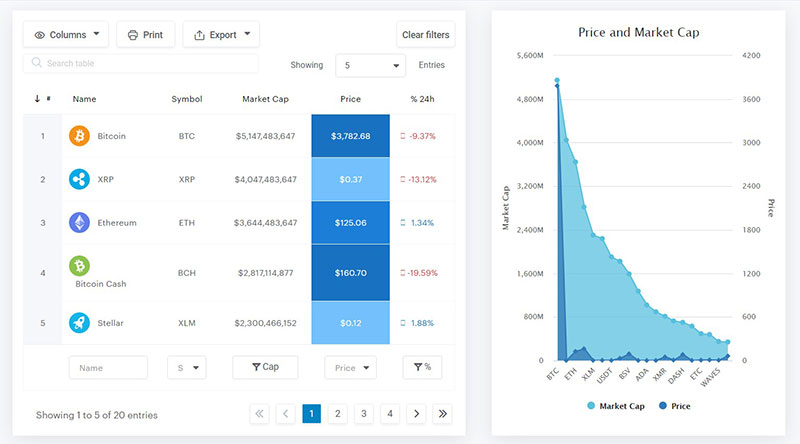
For most people reading this, wpDataTables. It’s a WordPress plugin that builds responsive tables and charts from Excel, CSV, XML, JSON, Google Sheets, and MySQL without a line of code, and it handles large datasets through server-side processing.
The logic is simple enough. DataTables’ biggest single gap is that it offers WordPress users nothing native, and that gap is exactly what wpDataTables fills.
Worth saying up front: wpDataTables publishes this article. The reasoning sits under every pick and each tool, ours included, gets an honest note on where it doesn’t fit. Several tools below beat wpDataTables outright for specific jobs, anything outside WordPress, enterprise-scale grids, spreadsheet-style editing, and free simple tables, and we’ve said so plainly in each case.
How we tested: we built the same 500-row dataset in every tool during July 2026. The WordPress plugins went onto a clean WordPress 6.9 sandbox; the JavaScript libraries went into a plain Vite project so bundle size and setup time were comparable. Where a feature sits behind a paid license we didn’t buy, notably AG Grid Enterprise and Handsontable’s commercial tier, we’ve said so rather than guessing at it.
The free Lite version runs on 70,000+ active WordPress installs per the WordPress.org plugin directory, with a 4.6-star rating.
It connects to more data than DataTables does out of the box:
- Excel (.xlsx, .xls, .ods), CSV, XML, JSON
- Google Sheets and live MySQL queries
- PHP arrays and serialized data
One real use case: agencies drop dynamic, customizable tables onto client sites without coding from scratch, using integration with page builders like Elementor and WPBakery. That’s the exact workflow DataTables never supported.
Where wpDataTables Beats DataTables
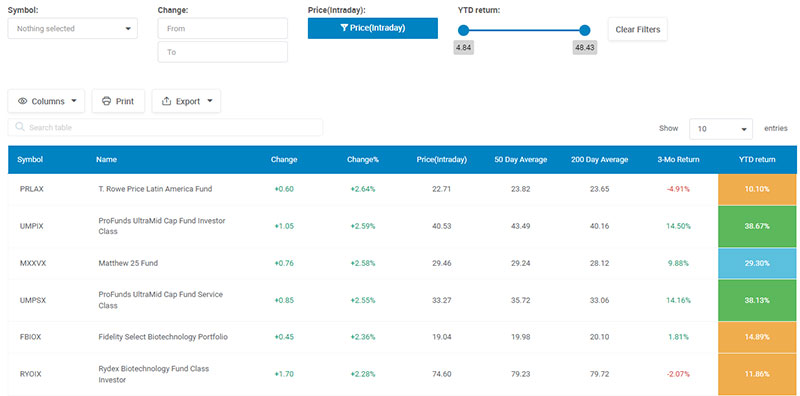
- No JavaScript init. A table wizard replaces every line of hand-written config
- Built-in charts. Generate visualizations powered by Google Charts, HighCharts, and Chart.js straight from your table data, something DataTables simply doesn’t do
- Conditional formatting and cell editing. Both work without bolting on extra plugins
Server-side handling pushes sorting and filtering to the database instead of the browser, which is what makes very large tables workable without dragging the page down. Advanced filtering, sorting, and responsive layout all ship in the box rather than as add-ons you configure yourself.
What we found testing it: the table wizard replaced what would have been an init script plus column config in DataTables, and a MySQL-backed table updated on page reload when the source data changed. Building a chart from the same rows took a couple of minutes and the chart stayed in sync when we filtered the table, which is the part no other no-code tool here matches. Two honest frictions. It loads more front-end assets than TablePress does, so on a single small table it’s heavier than the job needs. And the admin carries enough options that a first-time user spends real time orienting before the first table ships.
When wpDataTables Is Not the Right Fit
It’s a WordPress plugin. Outside WordPress, it doesn’t apply at all.
- Pure React or standalone JavaScript apps get no use from it
- Teams wanting a raw grid library to wire into custom code need a code-first option instead
If you’re not on WordPress, skip ahead to the JavaScript libraries below.
How Does TablePress Compare as a DataTables Alternative?
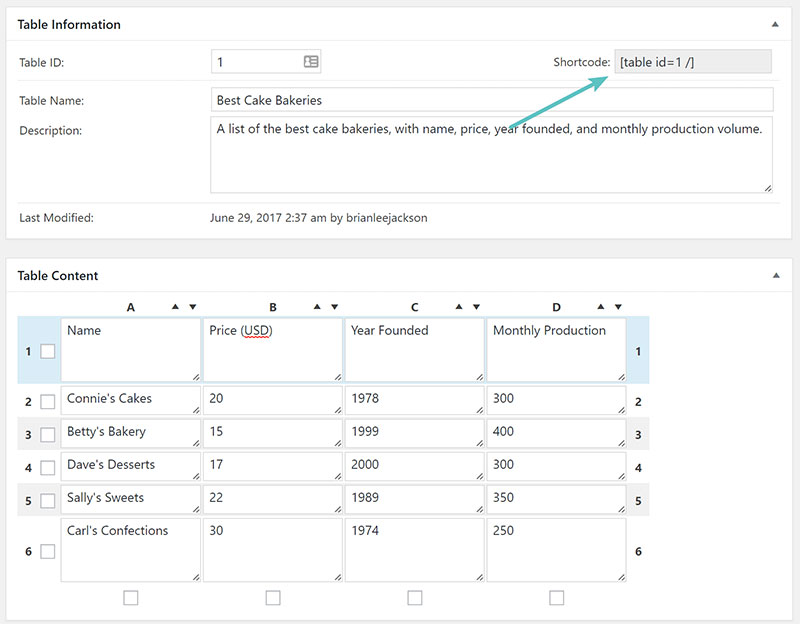
TablePress is the free WordPress-native option, and there’s a nice irony in it: its sorting and filtering run on the DataTables library under the hood. It inserts tables through shortcodes or a block and imports from CSV, Excel, JSON, and HTML, with advanced features living behind premium extensions.
It’s the go-to free pick for a reason. Simple tables, no cost, quick setup, and more than 700,000 active installs with a 5.0 average rating on WordPress.org, which makes it the most installed table plugin in the category by a wide margin.
Where it’s strong:
- Completely free for core table building
- Shortcode or block insertion into any post or page
- Clean import from common file formats
The limits show up fast once you need more. TablePress has no native charts on any tier, so pairing tables with visualizations means reaching for another tool. There’s no direct SQL connection either. Large-dataset handling is weaker than wpDataTables, and things like responsive modes or advanced filters sit inside paid add-ons.
What we found testing it: the spreadsheet-style editor was the fastest route to a working table of anything we installed, WordPress plugin or JavaScript library. It’s also the lightest on the page, loading minimal CSS and JS with no external dependencies. For a small static table we’d reach for it over wpDataTables without hesitating. The wall arrived when we tried to point it at a live data source, which isn’t possible on any tier, and when we looked for a chart, which also isn’t there.
Good for a small pricing table or a basic comparison. Thin for a data-heavy catalog.
Is Ninja Tables a Good DataTables Replacement?
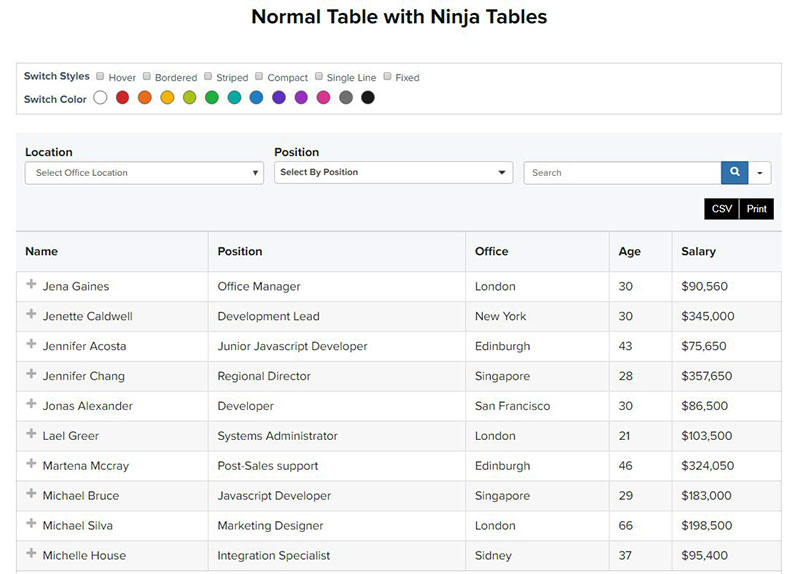
It’s a solid WordPress replacement built around a drag-and-drop editor. Responsive tables with conditional formatting, connections to Google Sheets and WordPress posts, and a free tier with Pro unlocking the advanced pieces.
WP Manage Ninja builds it, and it runs on 80,000+ active installs with a 4.6 rating (WordPress.org, 2026). The drag-and-drop approach is the selling point, though worth knowing that drag-and-drop building itself is a Pro feature. You arrange columns visually instead of configuring them.
Fluent design, responsive breakpoints, custom cell styling in Pro.
Where it lands against the other WordPress options:
| Tool | Builder | Native Charts | Best For |
|---|---|---|---|
| wpDataTables | Wizard | Yes | Data-heavy sites, charts |
| TablePress | Grid editor | No | Free simple tables |
| Ninja Tables | Drag-and-drop | Via Ninja Charts | Visual table building |
What we found testing it: the creation modal asks how you want to build before it asks anything else, manual entry, drag and drop, a Fluent Forms connection, or an external source, which is a genuinely different starting point from the other two. Responsive breakpoints worked on the free build, letting us hide chosen columns per device without writing CSS. Drag-and-drop building and charting both prompted for Pro when we tried them, and charts route through the separate Ninja Charts plugin rather than living in the same install.
The free version covers small tables well. Push into conditional formatting, Google Sheets sync, front-end editing, or larger data and you hit the Pro paywall quickly.
What Are the Best JavaScript DataTables Alternatives?
AG Grid, Tabulator, Grid.js, and Handsontable. All of them drop the jQuery dependency, work with React, Angular, and Vue, and cover everything from lightweight tables to million-row enterprise grids.
This is the group for developers building apps, not WordPress sites.
The ag-grid-enterprise npm package alone pulls well over 1 million weekly downloads, which tells you how much the app-dev world leans on it.
AG Grid for Enterprise Applications
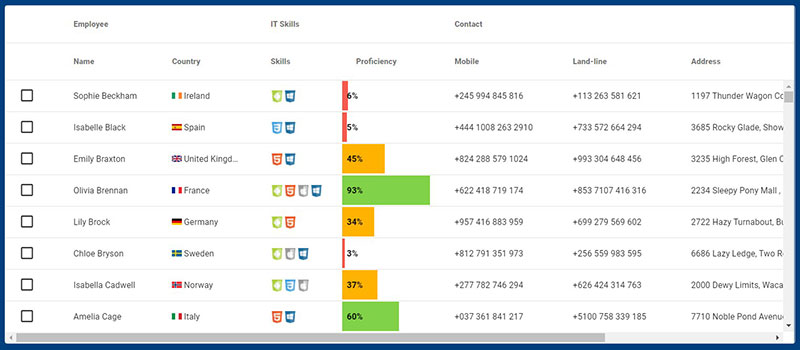
AG Grid is the enterprise standard for large, complex data grids. It splits into a free MIT-licensed Community tier and a paid Enterprise tier at $999 per developer, and it works across React, Angular, and Vue.
Read the licensing carefully, though. AG Grid licenses per developer seat, not per application or per site, so a five-person front-end team needs five licenses. Sources differ on whether the current model is a perpetual license with a year of support or an annual subscription, so confirm the terms on ag-grid.com before budgeting.
Row and column virtualization is the reason it handles huge datasets without lag. It renders only what’s on screen.
Enterprise adds pivoting, aggregation, integrated charts, and a server-side row model. Overkill for a small table. Perfect for a financial dashboard pushing hundreds of thousands of rows.
What we found testing it: we used the MIT Community tier in a React project. Virtualization is the headline and it delivers, scrolling stayed smooth where a browser-rendered table would have stuttered, because only visible rows exist in the DOM. Setup took longer than Grid.js or Tabulator, and the API surface is large enough that the docs stay open beside you for a while. Pivoting, aggregation, and integrated charts all sit in Enterprise, which we didn’t license, so we can’t speak to those from use. For anything at genuine scale, this is the strongest tool in this article and it isn’t close.
Tabulator and Grid.js for Lightweight Builds
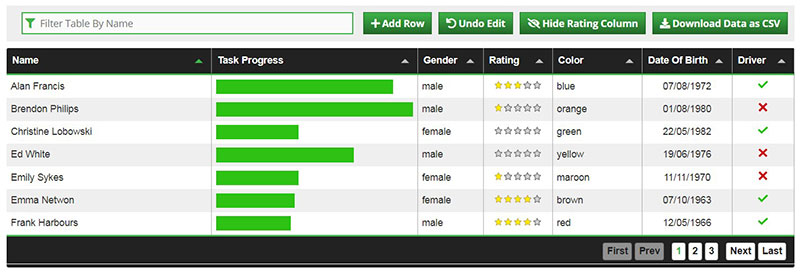
- Tabulator started as a jQuery plugin and is now a standalone library with no jQuery dependency. Feature-rich, MIT-licensed, builds interactive tables from JSON fast
- Grid.js has a tiny footprint and is framework-agnostic, which makes it the pick when bundle size matters and you just need a clean interactive table
Both beat DataTables on setup for modern projects, mostly because neither drags jQuery along. For a straightforward JavaScript data table on a plain page, Grid.js gets you there with minimal weight.
What we found testing them: Grid.js had the smallest footprint and the shortest path from install to a working sortable table, a handful of lines and it renders. It also runs out of road fastest once requirements grow past sorting, search, and pagination. Tabulator took longer to configure and gave back considerably more: column formatters, editable cells, grouping, and JSON loading all worked without add-ons. If you’re replacing DataTables in an existing project and want feature parity minus jQuery, Tabulator is the closest match on this list.
Handsontable rounds out the group for anyone needing spreadsheet-style editing, with Excel-like cell behavior baked in.
What we found testing Handsontable: the free non-commercial build behaves like a spreadsheet rather than a table, which is the entire point. Keyboard shortcuts carried over from Excel and Google Sheets worked as muscle memory expects, and cell editing felt native rather than bolted on. It ships 400+ spreadsheet formulas through HyperFormula. The commercial licensing is the friction: pricing isn’t published, so a commercial project means requesting a quote rather than reading a page.
How Do These DataTables Alternatives Compare on Features and Price?
The field splits into two camps: WordPress plugins (wpDataTables, TablePress, Ninja Tables) and JavaScript grid libraries (AG Grid, Tabulator, Grid.js, Handsontable). Pick by stack first, then by charts, data sources, and budget.
| Tool | Type | Charts | Price | Best For |
|---|---|---|---|---|
| wpDataTables | WordPress, no-code | Built-in | Free Lite + paid | Data-heavy WordPress sites |
| TablePress | WordPress, no-code | None | Free + paid add-ons | Simple free tables |
| Ninja Tables | WordPress, no-code | Via Ninja Charts | Free + Pro | Drag-and-drop building |
| AG Grid | JS library | Enterprise | Free $999/developer | Enterprise apps |
| Tabulator | JS library | None | Free MIT | Feature-rich JS tables |
| Grid.js | JS library | None | Free MIT | Lightweight builds |
| Handsontable | JS library | None | Free non-commercial paid commercial | Spreadsheet editing |
Adoption tells you which ones are battle-tested. On npm, ag-grid-enterprise leads the group at over a million weekly downloads, datatables.net still pulls several hundred thousand, and handsontable sits in the low hundreds of thousands. DataTables remains heavily used despite the jQuery dependency, so calling it “legacy” overstates things.
Two things the table doesn’t say outright:
- Charts are rare. Across the no-code group, only wpDataTables gives you charts built into the same plugin. Ninja Tables routes charting through its companion Ninja Charts plugin, and AG Grid gates charts behind Enterprise
- Free doesn’t mean capable. Grid.js and Tabulator are MIT-licensed and cost nothing, but you write code to use them. The free ride is developer time
Which DataTables Alternative Should You Choose?
The table above gives the mapping. This section covers how to work the decision, since the order you ask the questions in matters more than any individual feature.
Work it in this order:
- Stack first. This single question eliminates most of the list. WordPress site, and the three JavaScript libraries are irrelevant no matter how good they are. React or Vue app, and the WordPress plugins don’t apply at all. Nothing else narrows the field this fast
- Code appetite second. Inside the JavaScript group, the split is how much configuration you want to write. Grid.js asks the least and gives the least. AG Grid asks the most and scales the furthest
- Charts third. If you need graphs from the same data, the field collapses to wpDataTables in the no-code group and AG Grid Enterprise among the libraries. Everything else means installing a second tool
- Data source fourth. A live MySQL query or a Google Sheet rules out TablePress entirely, since neither is possible on any tier
- License last, and read it carefully. AG Grid charges per developer seat rather than per site, so team size drives the bill. Handsontable is free only for non-commercial use, and its commercial pricing isn’t published
A few tie-breakers that don’t fit the table:
Running a store changes the answer. A product catalog or WooCommerce shop shifts WordPress users toward wpDataTables, since it auto-generates WooCommerce product tables with add-to-cart built in. That’s a specific job TablePress and Ninja Tables don’t cover natively.
Replacing DataTables in an existing project is a different problem from starting fresh. Tabulator is the closest feature match minus jQuery, so it usually means the least rewriting.
Editing beats displaying for internal tools. If users need to change values rather than read them, Handsontable is the only real pick here, and a static comparison table that nobody edits is the wrong job for it.
Page weight matters on content sites. For a single small table on a blog post, TablePress stays lighter than wpDataTables. That’s a real advantage, not a consolation prize.
Frequently Asked Questions About DataTables Alternatives
What is the best alternative to DataTables?
wpDataTables is the best alternative for most WordPress users. It builds responsive tables and charts from Excel, CSV, MySQL, and Google Sheets without code, and handles large datasets through server-side processing. Outside WordPress, AG Grid or Tabulator are the better answer.
Is there a DataTables alternative without jQuery?
Yes. Tabulator, Grid.js, and AG Grid all run without jQuery. Each works with modern stacks like React, Vue, and plain JavaScript, which drops the extra dependency DataTables relies on.
What is the best DataTables alternative for WordPress?
wpDataTables leads for WordPress. TablePress and Ninja Tables are strong picks too, but wpDataTables adds built-in charts, conditional formatting, and connections to MySQL and Google Sheets that the others lack or gate behind Pro. For a small free table, TablePress is lighter and costs nothing.
Is wpDataTables free?
Partly. wpDataTables Lite is a free version on the WordPress directory with core table features. The premium version unlocks charts, more data sources, editing, and WooCommerce product tables. Check wpdatatables.com for current annual and lifetime pricing.
What is a good free DataTables alternative?
TablePress is the top free WordPress option, with a full free core rather than a limited tier. For developers, Tabulator and Grid.js are MIT-licensed and cost nothing. Free means you trade money for setup time, since code-based libraries need manual work.
Can I create charts from a table?
wpDataTables generates charts directly from table data using Chart.js, Google Charts, and HighCharts. DataTables offers no native charts, so pairing tables with visualizations there means adding a separate charting library.
Which DataTables alternative handles large datasets best?
AG Grid handles the heaviest loads through row and column virtualization, and in our testing it was the strongest tool here at genuine scale. wpDataTables manages very large tables with server-side processing. Both beat browser-only rendering, which crawls once tables hit tens of thousands of rows.
Do I need coding skills to replace DataTables?
Not with WordPress plugins. wpDataTables, TablePress, and Ninja Tables use visual builders, no scripting needed. JavaScript libraries like AG Grid and Tabulator do require code, so pick based on your comfort level.
What data sources can wpDataTables connect to?
wpDataTables pulls from 7 sources: Excel, CSV, XML, JSON, Google Sheets, PHP arrays, and live MySQL queries. That range beats DataTables out of the box and removes the need for manual exports.
Is AG Grid better than DataTables?
For app development, yes. AG Grid works with React, Angular, and Vue, skips jQuery, and scales to enterprise data. DataTables stays simpler for basic jQuery pages, but AG Grid wins on modern builds.
Conclusion
Choosing among DataTables alternatives comes down to one question: where does your site live, and how much code do you want to write?
WordPress users get the cleanest path with wpDataTables. No initialization scripts, native charts, conditional formatting, and direct links to MySQL, Excel, and JSON.
TablePress and Ninja Tables cover lighter jobs. Free, shortcode-driven, quick to set up.
Developers building React, Angular, or Vue apps lean toward AG Grid for scale, or Tabulator and Grid.js when bundle size matters.
Handsontable stays the pick for spreadsheet-style editing.
Match the tool to your stack, your data sources, and your budget. Skip the ones built for someone else’s setup.
For the bulk of WordPress sites, wpDataTables remains the strongest replacement.