A good free data source states its license and keeps its access method stable, whether that’s a file download, an API or a cloud query. The data dictionary is the part people skip, and it’s the part that saves the most time later.
Kaggle, the UCI Machine Learning Repository, Data.gov, World Bank Open Data and the Registry of Open Data on AWS all clear that bar, though not to the same degree.
Finding datasets stopped being the hard part a while ago. Google Research reported in 2020 that datasets described in schema.org markup had grown from about 500,000 in 2016 to almost 30 million.
What’s scarce is a dataset with terms you can reuse and documentation you can trust.
Table of Contents
Which Free Data Source Fits Which Kind of Project?
Start from the question the project asks. Learning projects do fine with small documented files. Economic and demographic work belongs with official statistics, and anything too big for a laptop disk goes to a cloud-hosted archive.
| Project type | Start with | Typical data |
|---|---|---|
| Dashboards and visualization | Our World in Data, World Bank Open Data | Country-level indicators |
| Machine learning | UCI Machine Learning Repository, Hugging Face Datasets | Labeled tabular, text, images |
| Economic and demographic analysis | FRED, US Census Bureau, Eurostat | Time series, survey tables |
| Geospatial and climate work | OpenStreetMap, NOAA, NASA Earthdata | Map features, station readings, satellite products |
| Large-scale processing | AWS Open Data Registry, BigQuery public datasets | Cloud-hosted archives |
Nearly everything in that table is secondary data, which someone else collected for a different reason. The columns rarely line up with your question, so leave time for reshaping.
If the project is going into a portfolio, pick a source fewer people use. Reviewers see the popular beginner files constantly, and those files signal very little.
Academic projects also need a clear record of where their data came from. Students searching for essay buy services or other forms of assignment assistance should still check their institution’s academic integrity rules. For data analysis coursework, documenting the original dataset, methodology and sources is essential, regardless of whether outside assistance was used.
A class assignment is simpler. Use whatever format the instructor specifies, which usually means a small UCI or Kaggle file.
The same approach works for students pursuing a graduate certificate in analytics. A well-documented public dataset gives them room to practice data cleaning, statistical analysis and visualization without spending most of the project finding or collecting data. For coursework, the source’s documentation often matters more than its size.
For a production prototype, a stable license and a stable endpoint matter more than anything else, and that rules out most community uploads.
General-Purpose Dataset Repositories and Search Tools
If the topic is still open, start with a search tool. Once the data type is settled, go straight to a repository. Search tools only point to files hosted elsewhere, while repositories keep the files themselves.
Search Tools That Index Other Sites
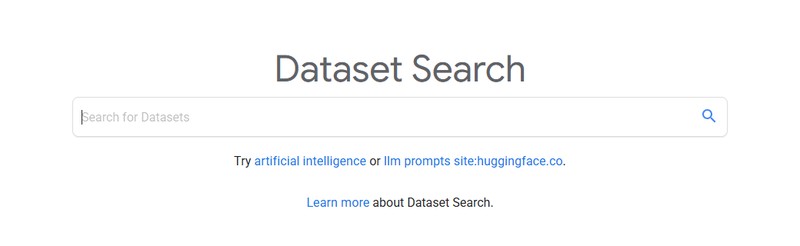
Google Dataset Search doesn’t host anything. According to Google Search Central, it reads schema.org Dataset markup (or the equivalent W3C DCAT format) from the pages that describe a dataset.
One catch is easy to miss. A dataset page without that markup doesn’t show up in results at all, as Google’s own team explained when the tool launched.
The Awesome Public Datasets list on GitHub works the other way around, with a person curating links by topic. Curated lists depend on their maintainers, so check each link’s license and last update yourself.
Repositories That Host Files
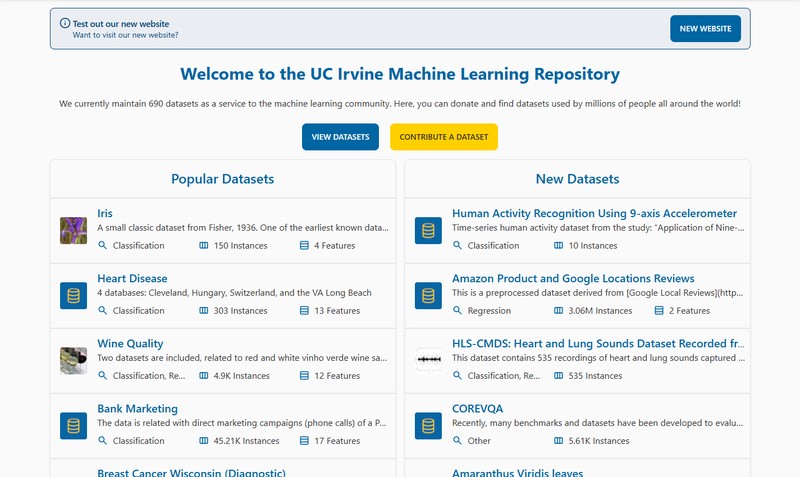
The UC Irvine Machine Learning Repository currently lists 690 datasets, per its own homepage, and its donation policy puts them under CC BY 4.0.
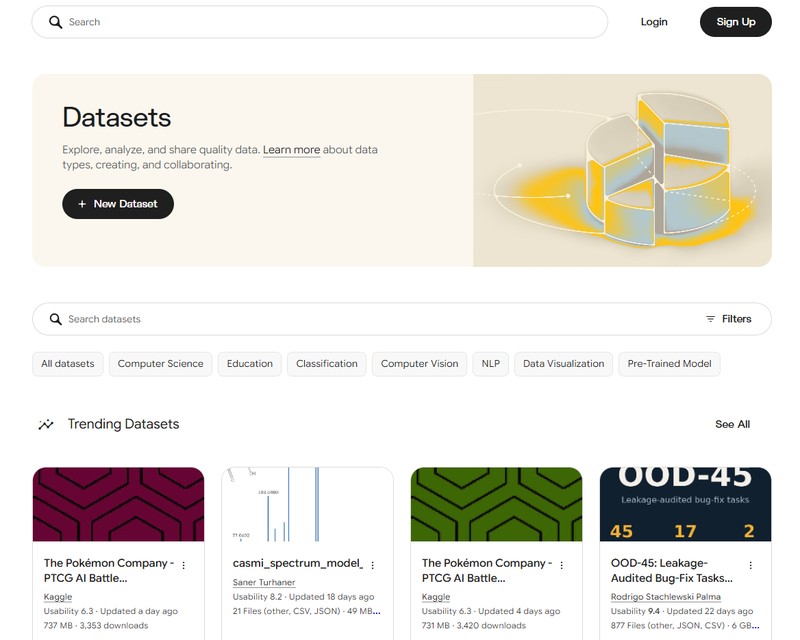
- Kaggle Datasets hosts community uploads with notebooks attached. The license is set on each dataset page, so read it before reusing anything.
- OpenML has benchmark-style tabular sets, mostly for machine learning experiments.
- Hugging Face Datasets is where to look for text, audio and image sets used in NLP and vision work.
- Zenodo takes research deposits and gives each a DOI, which makes citation simple.
Wikidata is the odd one out. It stores structured facts about people, organizations, places and plenty more, so it behaves like a queryable knowledge base rather than a file download.
Check licenses twice on aggregator hosts, because missing ones are common. The Data Provenance Initiative audited more than 1,800 text datasets in 2023 and found license omission above 70% on hosting sites such as GitHub and Hugging Face.
Government and Economic Data Sources
Agencies and international bodies publish the most reliable free data I know of. You pay for that with messier tables and more documentation to read. Most of it also follows a release calendar, so how often a source updates decides whether it fits.
US Sources
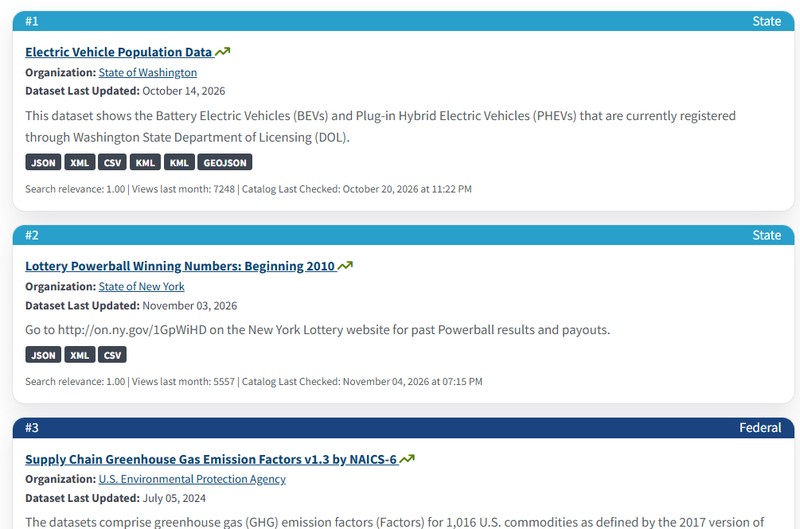
Data.gov works as a catalog of agency datasets rather than a single database, and it lists 532,497 of them as of November 2026. Filter by agency and file format before you open anything.
The US Census Bureau covers population, income and housing tables. The decennial census only comes around every 10 years, so the annual American Community Survey fills the gap. Every query to the Census Data API needs a free key.
FRED, from the St. Louis Fed, holds economic time series and sits behind an API that also needs a free key. Interest rate and inflation series chart nicely, and employment data does too, which is where guides to financial data visualization become useful.
European and Global Sources
Eurostat and the data.europa.eu portal cover EU statistics. Eurostat authorises commercial and non-commercial reuse with the source acknowledged, except for data credited to other sources and data for countries outside the EU, EFTA and candidate states, which cannot be reused commercially (Eurostat copyright notice).
World Bank Open Data uses CC BY 4.0 as the default license for datasets the Bank produces itself. Data from partners can carry other terms, so the license field on each dataset page matters (World Bank Data Catalog).
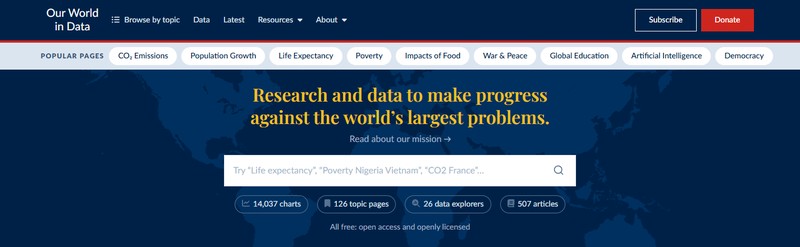
Our World in Data licenses its own charts and data under CC BY, but most of what it republishes comes from the WHO, UN and World Bank and keeps the original provider’s terms. It also offers direct URLs for CSV data and JSON metadata, which suits notebooks.
For a first project I’d go with Our World in Data, since it’s the easiest of the three to load. For anything you plan to publish, read the provider’s license, not the aggregator’s.
Geospatial, Climate and Science Data Sources
None of these is a plain download-and-go. OpenStreetMap wants a credit line. NOAA, which supplies weather and climate observations, wants a free token, and NASA Earthdata (satellite and earth science products) wants a free account.
OpenStreetMap data is licensed under the Open Database License (ODbL), and anything built on it must credit the project. The standard credit reads “(c) OpenStreetMap contributors” with a link to openstreetmap.org/copyright, according to the OpenStreetMap Foundation.
Machine learning work has a catch here. A training dataset that is a substantial extraction from OpenStreetMap counts as a Derivative Database, and if you use it publicly it has to be shared on ODbL terms.
Hosting costs money even when the data is free. OpenStreetMap’s copyright page says the project cannot offer a free-of-charge map API to third parties, so tile and geocoding calls follow usage policies, and bulk work starts from a downloaded extract.
NOAA’s Climate Data Online serves historical station observations through a web service, and a free token is required for every request. Daily readings load straight into time series charts, so visualizing weather data is the natural next step.
NASA Earthdata products cost nothing, though downloading them needs a free Earthdata Login. Browsing the website and using the Worldview imagery viewer doesn’t, per NASA.
File formats vary a lot here. Vector map features usually come as GeoJSON or shapefile, and most station readings are plain CSV. Satellite products are the awkward ones. They ship as gridded scientific files, which adds a tooling step before pandas can read them.
Cloud-Hosted Public Datasets for Large Projects
Cloud-hosted datasets let you query or read data right where it sits, and that starts to matter once a dataset outgrows a laptop disk. Reading is free. Whether the whole project stays free depends on compute and transfer rules.
For larger projects, cloud services can provide the storage and computing resources needed to process datasets without moving everything onto a local machine. The data itself may be free, but running queries, storing intermediate results and transferring files can still generate charges. Check those costs before choosing a cloud-hosted source for repeated analysis.
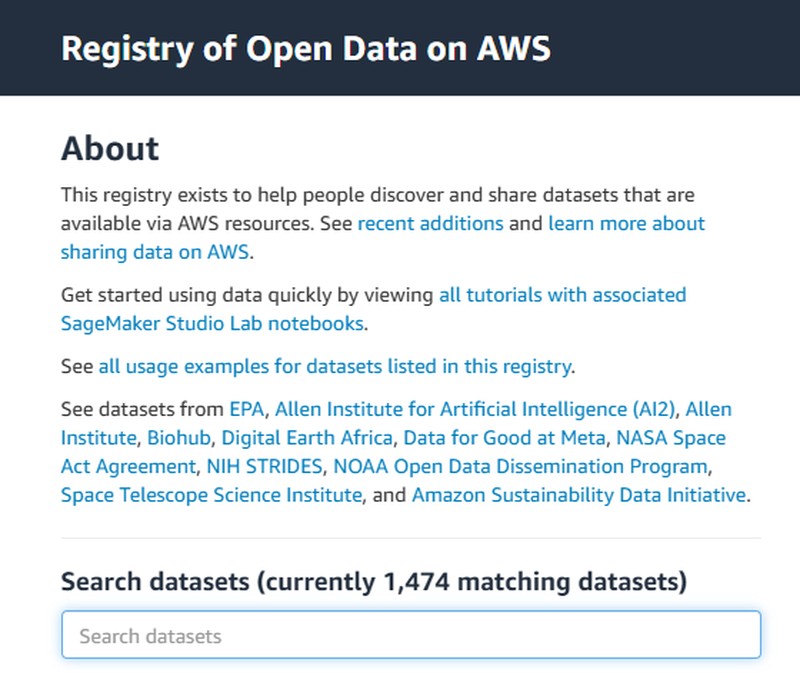
The Registry of Open Data on AWS passed 1,143 datasets in April 2026, with over 400 petabytes of cloud-optimized data, according to the AWS Public Sector Blog.
NASA is one of the largest contributors there, hosting Earth observation, climate and satellite mission data.
Google BigQuery public datasets work differently. You run SQL against Google-hosted tables and nothing downloads, though every query counts against your monthly free allowance, and billing starts once that runs out.
Common Crawl’s October 2026 release holds 2.16 billion web pages and 371.19 TiB of uncompressed content, per the project’s release notes. Some captured pages are truncated at a fetch size limit, so long documents arrive incomplete.
Direct S3 access has its own constraint. NSIDC says reading its Earthdata Cloud data in place needs an EC2 instance in the us-west-2 region, while downloading to a local machine stays free.
Querying in place saves you the download and the local storage, and it’s the right call for aggregations over the full archive. A downloaded sample works offline and costs nothing after the transfer. I’d use that for prototypes, charts and anything you’ll rerun a lot.
Reduce before you chart. Advice on visualizing a large dataset assumes a sample or an aggregate, not the raw archive.
What Limits Do Free Data Sources Put on Access?
Account rules, API keys, request quotas and storage or query caps all show up across free sources. None of them stops a small project, but they shape how you pull data, and a local copy beats repeated calls almost every time.
How the Data Arrives
A direct download is just a file link, usually CSV or JSON, and once it’s saved it works offline. That makes it the best fit for fixed snapshots.
With a REST API you request a series, station or indicator and get JSON back. Census, FRED and NOAA all want a key or token first.
Cloud queries run SQL against hosted tables, as with BigQuery public datasets. Nothing downloads.
Formats tend to follow the delivery method. Flat tables are usually CSV and nested records come as JSON. Parquet shows up for large columnar files, and GeoJSON handles map features.
pandas reads CSV, JSON and Parquet with read_csv, read_json and read_parquet. If the project ends on a web page, converting a JSON response into an HTML table takes a few lines.
On a WordPress site, wpDataTables skips that conversion step. It takes the URL of a JSON file, or a CSV or Excel file, and builds a sortable, searchable table from it.
Documented Limits
The figures below come straight from each provider’s documentation.
- The Census Data API requires a free API key on every query, according to the Census Bureau API user guide (May 2026).
- NOAA Climate Data Online allows five requests per second and 10,000 requests per day per token (NCEI documentation).
- The BigQuery sandbox gives you 1 TiB of processed query data per month and a lifetime limit of 10 GiB of storage, per Google Cloud documentation.
- FRED API keys are 32 characters, tied to a FRED account, with a distinct key for each application (St. Louis Fed documentation).
NOAA request counts reset daily, but the sandbox storage limit never does.
Working Within the Limits
Pull the data once and query your local copy. The same goes for a table on a website. A wpDataTables table linked to a source file reads that file on every page load, so turn on its data cache and let the auto-update refresh it on a schedule.
The Census Data API no longer has a keyless tier, so register for a free key before your first call and keep it out of public repositories.
Save raw API responses to disk before any cleaning, and register one key per project instead of reusing a single key everywhere. Export any BigQuery results you want to keep, because deleting data does not restore the sandbox storage limit.
Can You Use Free Datasets in Public or Commercial Projects?
Usually, as long as the license allows it and you meet its conditions. Free to download doesn’t mean free to reuse, since attribution and share-alike clauses decide what you can publish or sell.
The intended use matters just as much as the license. For example, publicly accessible records may be useful for research, but using them to conduct a background check can involve separate privacy, accuracy and legal requirements. A dataset being free to download does not automatically make it suitable for screening individuals or making decisions about them.
| License | Attribution | Commercial use | Share-alike |
|---|---|---|---|
| CC0 1.0 | Not required | Yes | No |
| CC BY 4.0 | Required | Yes | No |
| CC BY-SA 4.0 | Required | Yes | Yes |
| ODbL 1.0 | Required | Yes | Yes, for public use of adapted databases |
The table is based on the Creative Commons deeds and the Open Data Commons summary. Both describe themselves as summaries, so the full legal code is what actually governs. None of this is legal advice.
Creative Commons licenses cover works in general, while Open Data Commons licenses, the ODbL included, were written for databases.
Reading the License Field
Data.gov’s federal metadata standard includes a license field, supplied as a URL. On Hugging Face, each dataset card shows a license tag such as cc0-1.0. Kaggle’s dataset metadata lists license options that include CC0, CC BY-SA 3.0 and 4.0, plus “other” and “unknown”.
A CC BY credit needs the creator, a link to the license and a note on any changes. A line such as “Source: World Bank Open Data, CC BY 4.0, filtered to 2010 through 2020” covers all of it.
When the License Is Missing or Disputed
A dataset marked “unknown” gives you no stated permission. Trace it to the original publisher and read the license there.
Directories also contradict publishers. Innovatiana’s directory lists World Bank Open Data under ODC-BY, while the World Bank’s own data catalog names CC BY 4.0 as the default license for datasets it produces.
When they disagree, go with the publisher’s page, and screenshot it or save the license URL with your project files.
How to Check Dataset Quality Before You Commit
Check a free dataset before you build on it. A bad one found on day one costs far less than one found after the charts are done.
- Find the original publisher. A re-upload on a community host is a copy, not the source.
- Read the data dictionary and the last update date, then compare that date to the source’s release cadence.
- Load a sample in pandas and run info(), isna().sum() and duplicated().sum().
- Scan ranges and placeholders: minimum and maximum values, filler entries such as 9999999999, and mixed units like 0.80 versus 80 for the same percentage.
- Check the shape of each numeric column with a histogram and each text column with a frequency table.
- Compare one key figure against a second source that covers the same measure.
Atlassian’s guide to free datasets lists much the same concerns, namely source reputation, implausible values, missing data and skew.
The describe() method prints descriptive statistics for every numeric column, which exposes most range problems in a single call.
For skew, plot histograms of the columns your analysis depends on. One dominant value limits what the data can answer.
My rule of thumb is to switch to a better-documented source if two of those checks fail. Cleaning a weak dataset rarely beats finding a good one.
When Free Data Sources Fall Short
Free data stops being the right choice when it’s stale, undocumented, overused or locked behind restrictive license terms. A paid feed or your own collection is the better route then, and sometimes a data partnership.
Where Free Data Breaks
Even the World Bank flags its own gaps. Its WDI indicator monitor (December 2024) lists 778 of 1,490 indicators as missing required metadata and 55 as lacking the CC BY 4.0 license.
Stale snapshots are the most obvious problem. A source on a release calendar can’t answer a question about last week.
Quality is uneven too, particularly in community-contributed collections, so compare them with a reputable source on the same topic, as Atlassian advises. Well-known beginner files tell a reviewer little about your judgment. And share-alike or non-commercial clauses can block products you plan to sell or keep closed.
Skewed or unrepresentative collections also produce misleading statistics, and no amount of cleaning fixes a biased sample.
When to Pay or Collect Your Own
Free data is fine when the question fits the source’s release calendar and the license clears your intended use. It also helps if the documentation explains every column you rely on.
Paying, or collecting your own, makes sense once you need data refreshed daily or faster. Same goes for a license that blocks commercial or closed use, and for a niche no public source covers.
Switching sources partway through is normal. It doesn’t mean the project failed.
Free Data Sources FAQ
Can you re-upload a downloaded dataset to GitHub?
Only if the license allows redistribution. CC0 and CC BY 4.0 do, and CC BY requires credit, a license link and a note on any changes.
CC BY-SA and the ODbL add share-alike, so adapted copies keep the same license. A dataset marked “unknown” gives you no permission.
How do you cite a free dataset in a portfolio project?
A citation needs the creator, dataset title, publisher, year, URL or DOI and access date, with the license name added at the end. UCI assigns a DOI to approved datasets, so the citation gets a permanent link.
Under CC BY the credit and license link are required anyway.
Which free datasets work for SQL practice?
BigQuery public datasets run SQL directly, with nothing to download. For a local setup, import CSV files from UCI or Kaggle into SQLite or PostgreSQL.
Choose sources with several related tables, because joins are the skill most practice files fail to test.
Is web scraping a fair fallback when no dataset exists?
Sometimes. When no suitable public dataset exists, website data scraping can help collect information directly from publicly accessible pages. Look for an API or a Common Crawl extract first, then read the site’s terms of service and robots.txt before writing a scraper.
The site’s terms and copyright still apply to what you collect. This is general information, not legal advice.
Where do you find open data for countries outside the US and EU?
Start with the country’s national statistics office or its open data portal. If neither publishes usable files, World Bank Open Data covers 217 economies in its World Development Indicators (World Bank, December 2024).
Do free data sources offer real-time data?
Rarely. Most publish on a release schedule, from the decennial Census count to regularly updated series, so confirm the update frequency on the dataset page.
For live feeds, pick a source built for streaming and read its usage limits first.
Standing Out With Free Data Sources
A project built on free data sources stands out through the question it asks and the documentation around it, not through the dataset itself. Popular beginner files are familiar to every reviewer, so the file alone signals nothing.
Write the question down before picking a source, and record the publisher, license and access date in the README as you go. Joining a second source on a shared key, such as country and year, is what turns a basic project into a more interesting one.
The order matters because a question filters sources in minutes, while a README written last drops whatever you no longer remember.
There’s a cost to joining sources, which is extra obligation. Each one brings its own attribution line, and a share-alike clause on either covers the combined result.
Source terms and access limits change, so recheck both if the project outlives November 2026, the date this position was verified.
Once the data is loaded, choosing the right chart for your data is the natural next step. If the table already lives in wpDataTables, the chart wizard builds that chart from the same rows.