The best WordPress data visualization plugins for most sites come down to wpDataTables, Visualizer, Ninja Charts, Chartify and GravityCharts. They were picked on how many data sources and chart engines each one supports, since that’s where they really differ.
Chart type counts barely separate them. What matters more is the data source. Visualizer’s free version accepts manual entry only, while CSV, Google Sheets and database imports require Pro (Themeisle documentation and Visualizer listing on WordPress.org, 2026). GravityCharts won’t run at all without Gravity Forms.
Each plugin also draws its charts with a library like Chart.js or Google Charts. That engine determines the licensing terms and how scripts load, and it limits what you can do for accessibility.
Table of Contents
Which are the best WordPress data visualization plugins?
Breadth of data sources and chart engines came first in the ranking, and price second. Together these five cover most of what people actually ask a chart plugin to do.
Plugins that only build tables or collect survey answers didn’t make the cut. Charts have to be the main output, whether the data sits in a spreadsheet or a database, or arrives through form submissions.
| Plugin | Chart engines | Data sources | Best for |
|---|---|---|---|
| wpDataTables | Google Charts, Chart.js; Highcharts and ApexCharts on paid tiers | MySQL (paid), Excel, CSV, Google Sheets (paid), JSON, XML | Large or database-driven datasets |
| Visualizer | Google Charts, Chart.js | Manual entry on free; CSV, Google Sheets and database on Pro | Basic charts on a free plan, with a Pro upgrade path |
| Ninja Charts | Chart.js, Google Charts | Manual, CSV, Ninja Tables, Fluent Forms | Free charts beside Ninja Tables or Fluent Forms |
| Chartify | Google Charts (changelog also lists some Chart.js types) | Manual on free; Google Sheets and database query on Premium | Org charts and quiz result charts |
| GravityCharts | Chart.js | Gravity Forms entries | Reporting on form submissions |
wpDataTables
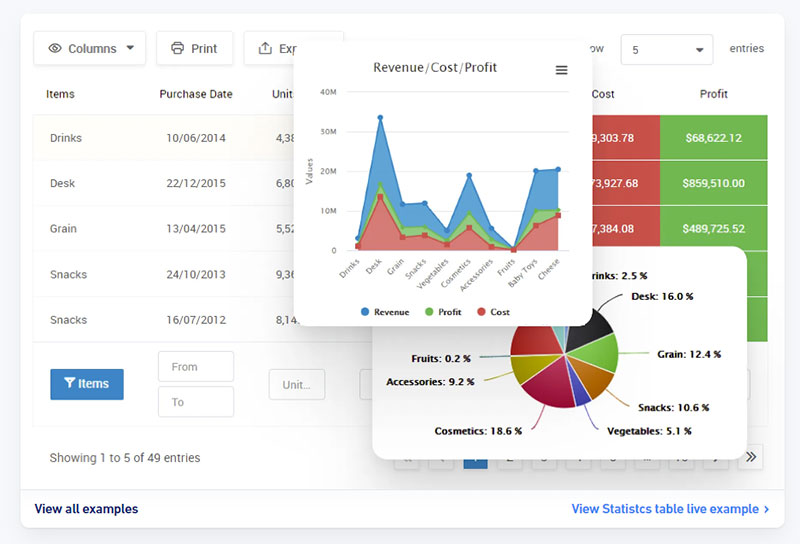
wpDataTables has over 60,000 active installations and a 4.5-star average across roughly 450 reviews on WordPress.org (WordPress.org listing, November 2026). That’s the biggest base of the five.
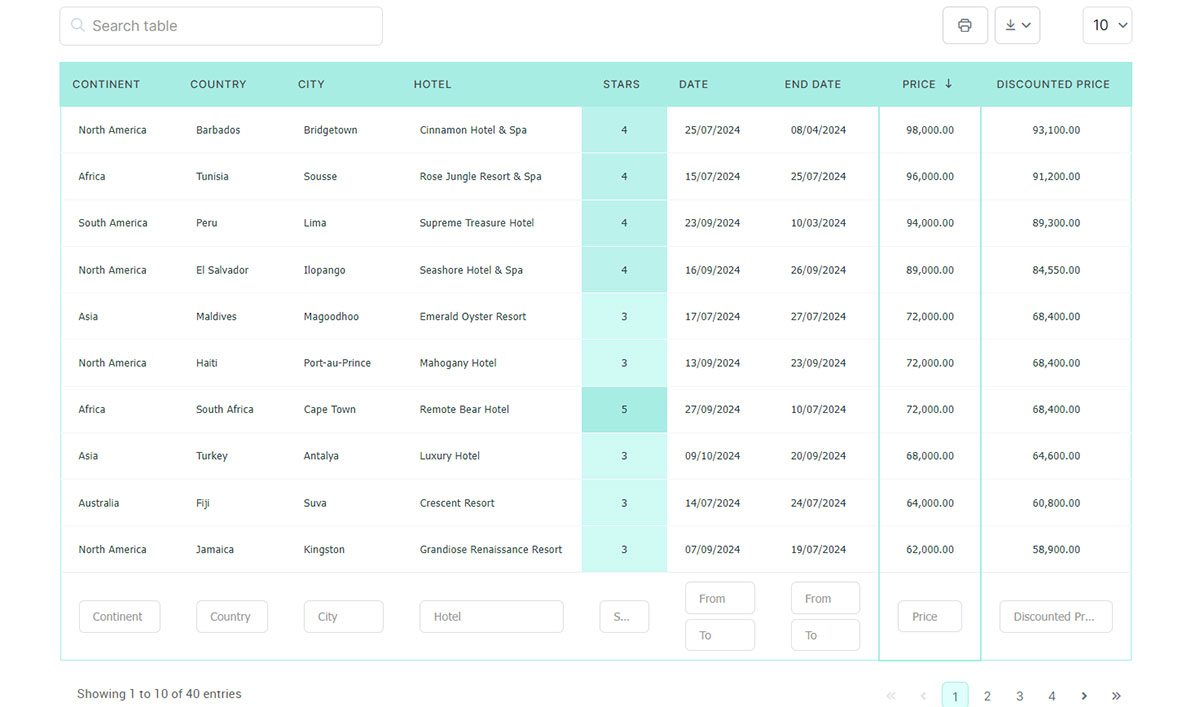
Charts here sit on top of a table you already manage, so the table and the WordPress charts built from it never drift apart. If your data already lives in tables, this is the one I’d look at first.
Per the documentation, sources include MySQL queries, Excel, CSV, Google Sheets, JSON, XML and serialized PHP arrays. The WordPress.org listing flags MySQL, MS SQL, PostgreSQL and Google Sheets as premium, so the free version is limited to Excel, CSV, XML, JSON and PHP arrays.
Four chart engines ship in one plugin, though Highcharts and ApexCharts sit on the paid tiers. Large MySQL tables get server-side processing, and front-end editing arrives with the Standard tier and above.
On the downside, every chart needs a wpDataTable behind it, so there’s no manual-entry chart option (Ninja Tables comparison). The Standard license also leaves out WooCommerce integration and folders, along with Highcharts Stock (wpDataTables help center).
License prices differ between third-party roundups for the same tiers. Check the vendor’s pricing page before budgeting.
Visualizer

Themeisle’s Visualizer is probably the easiest way in if all you want is a simple chart. The free version gives you four chart types (line, bar, pie and table) plus manual data entry (Themeisle documentation).
Pro starts at $99 per year and brings the library to 15 chart types, according to GravityKit’s comparison and Themeisle’s upgrade page. The current WordPress.org listing also advertises a built-in AI generator.
Charts and tables come out responsive, and the learning curve is gentle. Output goes through an Elementor widget or a shortcode. The catch is that CSV import and Google Sheets need Pro, and so do database connections. Design control is also modest next to Highcharts-based setups.
Ninja Charts

Ninja Charts has no paid tier at all. It lists 12 chart types (WordPress.org headlines it as “10+”), and you can choose Chart.js or Google Charts per chart, according to the Ninja Tables documentation.
Data can come from Ninja Tables, Fluent Forms, a CSV import or manual entry, which suits sites that already run those two plugins and not much else.
It works for small to mid-sized datasets and quick charts when there’s no budget. The documented sources stop at Ninja Tables, Fluent Forms, CSV and manual entry, so Sheets or MySQL data has to pass through a table first. CSV import only arrived in version 3.4.2, and that release’s changelog also lists a fix for large CSV imports freezing, so check your version before loading big files.
Chartify
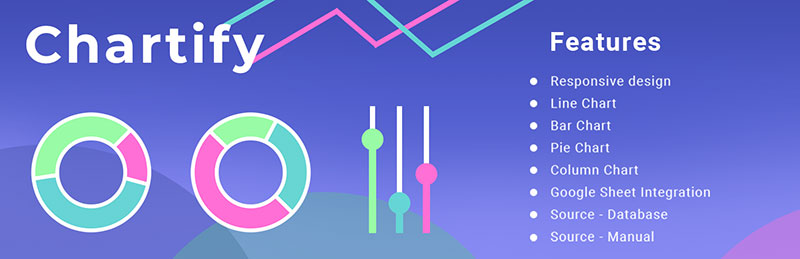
Ays Pro’s Chartify lists 22 chart types on WordPress.org, but only four are free (line, bar, pie and column). The other 18 need Premium, and that group includes donut, histogram, geo, org and area charts.
Data entry is manual on the free version, with Google Sheets and database query as Premium sources. Charts go on the page through a Chart Builder block or the [ays_chart id="chart_id"] shortcode. Rendering is done by Google Charts, per the developer’s readme, although the changelog also lists Chart.js chart types from version 2.7.6.
It’s strongest on org charts, and on quiz result charts through the Quiz Maker connection.
The Google Sheets tier is easy to misread, though. The main WordPress.org description presents Sheets and database queries as data sources without naming a tier, but the plugin’s feature list places Google Integration and Database Entry under Premium, and GreenGeeks’ tutorial (Chartify 3.2.4) places Sheets sync in Pro. Treat both as paid and confirm before building around them.
GravityCharts
Skip this one unless Gravity Forms already runs the site.
It draws line (with area), bar (with column), pie (with doughnut), polar area and radar charts, and each chart reads from a single form. On the page it shows up as a shortcode, a block or a GravityView widget, and image charts can go into emails and Gravity PDF.
Pricing starts at $99 and a separate Gravity Forms license is required (GravityKit). The real limit is that it charts Gravity Forms entries and nothing else, so a CSV file or database table never reaches it.
Which chart types, rendering libraries and export options do the plugins offer?
Under the hood these plugins lean on Chart.js, Google Charts, Highcharts and ApexCharts. wpDataTables bundles all of them. Ninja Charts and Visualizer use two each, Chartify is built on Google Charts (its changelog also mentions Chart.js types) and GravityCharts uses Chart.js alone.
| Library | Renders as | License | Used by |
|---|---|---|---|
| Chart.js | Canvas | Open source (MIT) | wpDataTables, Visualizer, Ninja Charts, GravityCharts |
| Google Charts | SVG | Free, hosted by Google | wpDataTables, Visualizer, Ninja Charts, Chartify |
| Highcharts | SVG | Commercial for business use | wpDataTables |
| ApexCharts | SVG | Dual license: free Community License under $2M annual revenue, commercial license above | wpDataTables |
Four of the five document Chart.js, the open source canvas library, as an engine, and Chartify’s changelog lists a few Chart.js types too. If there’s a chance you’ll switch plugins later, that’s the safest one to build around.
Google Charts loads from Google’s gstatic.com loader. Google’s terms do not allow downloading the code to self-host it (Google Charts FAQ).
Highcharts is where the licensing gets awkward. Its end-user license agreement requires a commercial license for business use and freelance client work, and wpDataTables’ documentation says Highcharts needs a separate license for commercial use. ApexCharts has a similar catch since it left the plain MIT license: organizations with $2 million or more in annual revenue need a commercial license. Check the plugin vendor’s terms to see whether the plugin license covers either library.
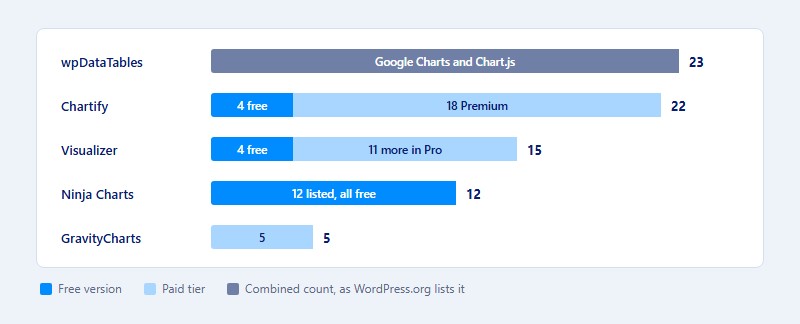
Chart type counts are all over the place. wpDataTables varies by engine, and not every type from the engines’ own sites is included (wpDataTables FAQ), though WordPress.org counts 23 types across Google Charts and Chart.js. Visualizer has 4 free and 15 in Pro. Ninja Charts shows 10+ (12 listed), Chartify has 22 with 4 free, and GravityCharts has 5.
Export differs more than chart types do. Ninja Charts picked up CSV, PNG and PDF export in version 3.4.2 (June 22, 2026), and Visualizer lists chart export among its Chart Library operations in Themeisle’s documentation. wpDataTables exports table data to CSV, PDF and XLS.
Which data sources can each plugin connect to?
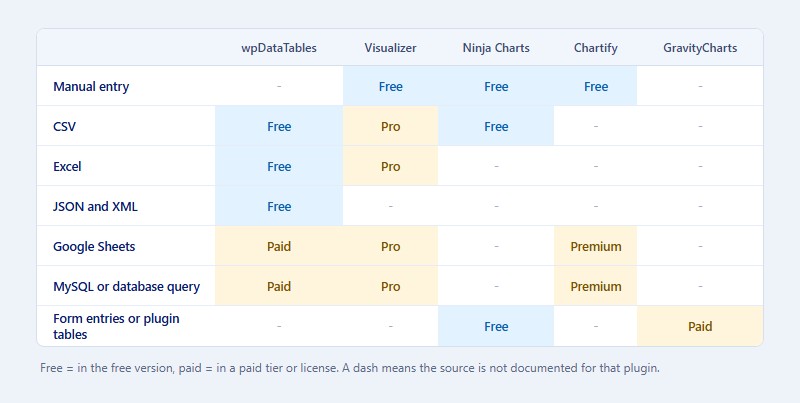
wpDataTables reads the widest range of sources, with MySQL queries, Excel, CSV, Google Sheets, JSON, XML and serialized PHP arrays all in the documentation (wpDataTables documentation). MySQL, MS SQL, PostgreSQL and Google Sheets need a paid license, though. Visualizer, Chartify and Ninja Charts cover fewer, and Visualizer keeps CSV, Google Sheets and database imports behind its Pro plan.
Spreadsheets and files
For CSV, wpDataTables handles it out of the box, Ninja Charts does from version 3.4.2 onward, and Visualizer needs Pro. Excel works in wpDataTables (.xls, .xlsx, .ods) and in Visualizer Pro (XLSX). Google Sheets is supported by wpDataTables (paid), Chartify (Premium) and Visualizer Pro.
Sheet-driven charts update when the source changes. wpDataTables tables linked to a Google Spreadsheet auto-update, and Visualizer replaced WP-Cron with Action Scheduler in version 4.0.0 (March 31, 2026) to improve auto-sync reliability.
For a full walkthrough, see this guide to charting live Google Sheets data.
Databases
Database-backed charts are where plugin choice matters most.
According to the wpDataTables documentation, tables without server-side processing suit roughly 2,000 to 3,000 cells. For SQL-query tables above 2,000 rows it switches server-side processing on automatically, and past roughly 3,000 to 4,000 rows it’s mandatory. Paid licenses can also connect to external MySQL, MS SQL and PostgreSQL databases.
Chartify supports a database query as a source (Premium), and Visualizer needs Pro for database imports. If you are pulling database rows into a WordPress page for the first time, start with the plugin that documents the query step most clearly.
A query that returns hundreds of thousands of rows without indexes will still run slowly, and wpDataTables’ documentation puts that delay on the MySQL side, not the plugin.
Where the sources disagree
WP Engine’s roundup counts missing MySQL retrieval as a wpDataTables drawback, yet wpDataTables’ own documentation treats MySQL query tables as a core feature. The documentation is the primary source, and since WordPress.org lists MySQL as a premium source, the roundup probably describes the free version or is just outdated. Confirm the MySQL option in your license tier before buying.
How well do the plugins work with Gutenberg, Elementor and shortcodes?
All five insert charts through a shortcode, and most add a block or widget on top. The gaps sit in the editors: Visualizer’s Elementor widget only arrived in version 4.0.0 (March 31, 2026), and Ninja Charts added a native Gutenberg block in version 3.4.0 (March 6, 2026).
wpDataTables supports the block editor and Elementor (WPShout) on top of shortcodes. Visualizer gives you a shortcode from the Chart Library and a Gutenberg block, plus the Elementor widget since 4.0.0. Ninja Charts has a shortcode and a native Gutenberg block. Chartify offers a Chart Builder block and a shortcode, and GravityCharts adds a block, a shortcode and a GravityView widget, along with a merge tag for image charts.
Shortcodes are the common denominator. To embed a chart in Divi or the classic editor, paste the shortcode into any text area.
Charts that start hidden are the usual breakage.
Visualizer fixed rendering for charts inside tabs and hidden containers in version 3.10.7 (February 6, 2024). Test any plugin inside your own accordion or tab block before rolling it out.
Do chart plugins slow down a WordPress site?
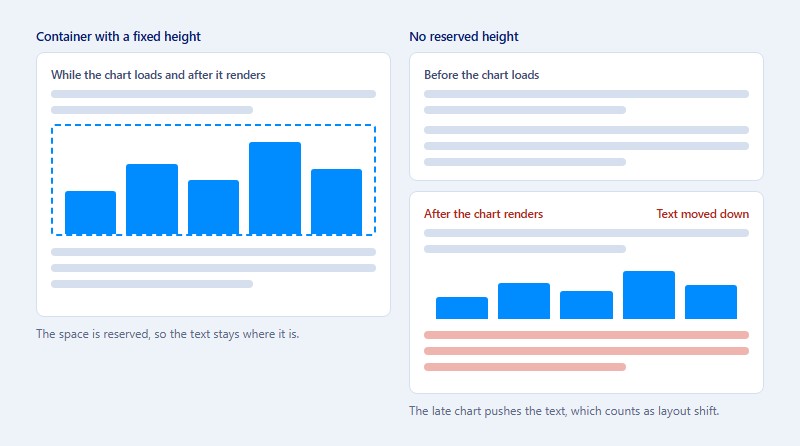
They add JavaScript to every page that carries a chart, and a chart that renders late shifts the layout around it. Google’s good threshold for layout shift is a CLS of 0.1 or less, measured at the 75th percentile of page loads (web.dev).
web.dev names late-arriving content and elements without set dimensions among the causes. Both describe a chart container that has no reserved height.
Freshy Sites recommends scoping the chart script to the post types that use it. The write-up gives no benchmark for the saving, so treat it as a rule of thumb.
- Load the chart script only on pages that actually contain a chart
- A fixed height on the chart container stops the jump
- Fewer charts per page helps too (Nexter’s advice)
- If the plugin runs on Google Charts, expect an external request to gstatic.com
Source-linked tables re-read their data on every page load, and wpDataTables’ documentation warns this can slow a page when the source is large. A WordPress caching plugin softens the cost, but updated data waits until the cache clears.
If a chart script sits in the head, check it against PageSpeed Insights warnings about render-blocking scripts.
Are plugin-generated charts responsive and accessible?
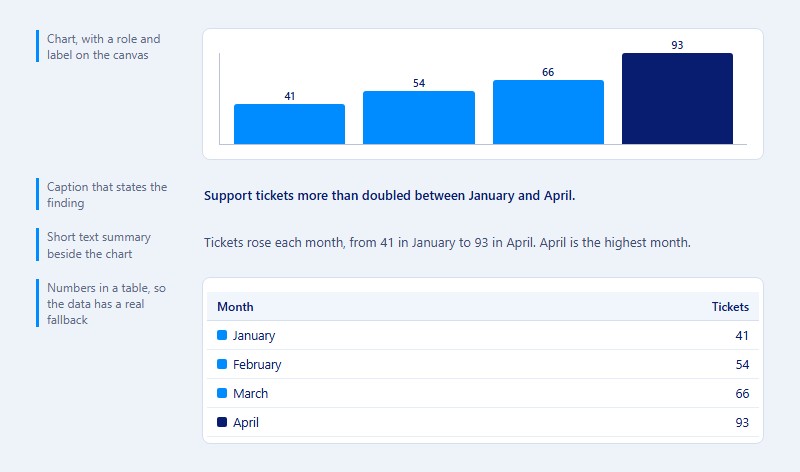
Responsive, usually yes. Accessible, only if you add the text a screen reader needs, because none of the five plugin listings retrieved for this guide document text alternatives or data table fallbacks (GravityKit says only that GravityCharts is tested for accessibility).
Responsive behavior on mobile
Visualizer and Chartify both advertise responsive output on their WordPress.org listings. Under the hood, a Chart.js chart resizes only inside a container that is relatively positioned and holds nothing but the canvas (Chart.js documentation).
In practice that means every canvas needs its own container, because Chart.js sizes the canvas from its parent. Resizing for print takes extra code, so a chart can print at the wrong size. And look at the chart at phone width, not only in the editor preview.
What WCAG asks of a chart
Alt text on a chart fixes less than you’d hope. Even when a chart has basic accessibility features such as alt text or a data table, screen-reader users spend 211% more time with online data visualizations and are 61% less accurate at pulling out the data than non-screen-reader users (Sharif and colleagues, University of Washington, 2021 and 2022).
WCAG 2.2 has a few criteria that bite here. 1.1.1 Non-text Content wants a text alternative that serves the same purpose as the chart. 1.4.1 Use of Color says color can’t be the only way to tell series apart, and 1.4.11 Non-text Contrast asks for 3:1 contrast against the background on graphics required for understanding.
W3C’s failure technique F13 names the usual miss. A text alternative that leaves out what the colors encode fails both 1.1.1 and 1.4.1.
Canvas, ARIA and a practical fix
A canvas chart is a single bitmap to assistive technology. Chart.js documents that accessibility has to be added with a role and aria-label on the canvas, or with fallback content inside the canvas tags.
Whether a plugin exposes those attributes is something to verify with a screen reader, not assume. Pew Research Center reworked its chart alt text in 2023 after noticing that repeating a broad chart headline tells a reader very little.
A fix that works with any plugin: wrap the chart in a figure with a caption that states the finding. Put a short text summary next to it, and offer the numbers in a table. Follow the guidance on accessible tables and that last piece becomes a real fallback instead of decoration.
Color needs the same treatment. Direct labels or patterns plus a tested data visualization color palette keep series readable for color-blind visitors.
Which plugin should you choose for your situation?
Start with the data source. A plugin that cannot read your data is out, whatever it costs, and budget only matters after that.
| Situation | Pick | Why | Limit |
|---|---|---|---|
| Spreadsheet or CSV, no budget | Ninja Charts | Free CSV import (version 3.4.2 and later) and 12 chart types | Sheets and MySQL data must pass through a table first |
| Database-backed or large tables | wpDataTables | MySQL queries with server-side processing | Each chart needs a table behind it; MySQL needs a paid license |
| Ninja Tables or Fluent Forms already installed | Ninja Charts | Free, reads both plugins directly | Few other sources |
| Gravity Forms reporting | GravityCharts | Charts form entries without export | From $99 plus a Gravity Forms license |
| Org charts or quiz results | Chartify | Org chart type and a Quiz Maker connection | Org charts are Premium |
If you only need one or two charts from a CSV file, the cheap option is enough. Ninja Charts covers that for free, and a paid license adds nothing. Visualizer’s free plan takes manual entry only, so CSV import there needs Pro.
The obvious pick can be wrong too. wpDataTables has the largest install base of the five, yet a single static chart gains little from a plugin built around tables. If readers will mostly look values up, weigh charts against tables before installing anything.
Editor fit rarely decides the pick. Every plugin here outputs a shortcode, so the page builder only breaks ties.
How do you add a chart to WordPress with a plugin?
The steps are the same for every plugin here. Only the screen names change.
- Install and activate the plugin. Use Plugins, Add New, or upload the ZIP from WordPress.org.
- Pick the chart type for the question you’re answering. The guide on how to choose the right chart for your data maps comparison, trend and share questions to bar, line and pie charts.
- Load the data. Upload the CSV, link the Sheet or paste the query, then check the column types. wpDataTables guesses each column type on import and lets you change it.
- Add a title, units and direct labels, and pick colors that pass 3:1 contrast.
- Insert the chart with the block, the Elementor widget or the shortcode, then add a caption and text summary under it.
- Test it. Check phone width, run a keyboard-only pass, look at the page with caching on, and check the chart again after you change a source value.
Most failed first attempts trace to step 3. Dates imported as text and numbers imported with thousands separators produce empty or flat charts.
When should you skip a chart plugin?
Skip the plugin if it’s unmaintained, or if the chart can live on an outside service. A single chart with odd requirements is another reason. The unmaintained case is the one that causes damage.
Abandoned and outdated plugins
WordPress.org flags a plugin that has not been tested with the latest 3 major releases of WordPress. The notice replaced an older two-year warning in 2018 (WordPress Developer Resources).
Maintenance matters for security, not only features. Patchstack’s 2026 report found that plugins held 91% of new WordPress vulnerabilities in 2025, and that 46% had no fix available when they were made public.
Visualizer shows the other side of that coin. Wordfence reported an authenticated SQL execution flaw in a May 2024 post, after receiving the report in April, when the plugin had more than 30,000 active installations. Version 3.11.0 (May 13, 2024) fully fixed it.
Visualizer’s changelog lists further security fixes since, including an unauthorized REST data-access fix in 4.0.7 (July 30, 2026), and Wordfence’s database lists other issues patched in 2025 and 2026, such as a Contributor-level SQL injection fixed in 3.11.14. A long record of fast patches is a better sign than a short record on a plugin nobody updates.
Install counts also disagree. The WordPress.org description for Visualizer says over 30,000 users, and Wordfence reported more than 30,000 installations in 2024, while the listing’s sidebar now reads 20,000+ active installations.
Either the counter moved down a band or the description text lags. Read the live number in the plugin’s sidebar before relying on any of them.
If an unpatched plugin has already been exploited, follow a recovery guide for a hacked WordPress site before reinstalling anything.
Custom Chart.js builds
One chart with non-standard data, or one that must sit in the post editor with exact styling, is a case for code. Chart.js is open source, and the cost is development time.
Accessibility also becomes your job, since Chart.js leaves the canvas markup to the author. Compare the main JavaScript chart libraries before committing, because SVG-based options handle some of that work differently.
External embed services
Datawrapper and Flourish produce responsive embeds you paste into WordPress. Datawrapper adds an alternative-description field for each chart and says an embedded chart is more accessible than a screenshot.
| Option | Free plan | Trade-off |
|---|---|---|
| Datawrapper | Unlimited charts, embeds and PNG export, with an attribution line | Charts and data live on Datawrapper’s servers |
| Flourish | Unlimited projects, public pages, embeds with attribution | Free projects are indexed by search engines; paid plans add passwords and remove attribution |
| WordPress plugin | Ninja Charts free version; Visualizer free version for basic charts | You own updates and security |
Pricing and limits are as of November 2026 and change often. Check each vendor’s page before building anything on a free tier.
FAQ About WordPress Data Visualization Plugins
Do I need to know how to code to use a chart plugin?
No. Charts get built from an admin screen, and the plugin hands you a shortcode (or a block, in most cases) to drop into the page.
Code only enters the picture with a custom Chart.js build, where you also write the accessibility markup yourself.
Can Google read the data inside a plugin-generated chart?
Not reliably. A canvas chart is a single image to a crawler, so the figures never become page text.
Put the finding in a caption and the numbers in a table beside the chart, and that text can be read and indexed.
What happens to my charts if I deactivate or switch plugins?
They stop rendering. Shortcodes belong to the plugin that registered them, so a tag like [ays_chart id="chart_id"] from Chartify shows up as plain text once the plugin is off.
Charts do not migrate between plugins either. Keep the original data files and rebuild.
Can I run two chart plugins on the same site?
Yes, and some setups need it, such as wpDataTables for tables and GravityCharts for form entries.
The cost is weight. Each plugin loads its own charting library, so two plugins can ship Chart.js and Google Charts on the same site.
How much do chart plugins cost?
Ninja Charts costs nothing. Visualizer and Chartify both have free versions, with paid tiers adding chart types and data sources.
GravityCharts is paid only, from $99, on top of a Gravity Forms license.
Choosing a Chart Plugin You Can Keep Updated
The right pick among WordPress data visualization plugins is the one that reads your existing data source and still receives updates. Styling can change later, but a missing connector cannot.
Check the connector first, then the update record and compatibility. The text fallback for each chart comes last, and it’s the part people skip.
Running a single plugin keeps one charting library on the page. The price is losing chart types that exist only in another plugin’s engine.
This position holds as of November 2026. Recheck it if Visualizer’s free version adds CSV or Google Sheets import, since that would reopen the no-budget pick.