
WordPress table generator plugins take spreadsheets, databases, and manually entered data and turn them into sortable, filterable tables you can drop into a page or post.
wpDataTables does this by connecting straight to MySQL, MS SQL, and PostgreSQL databases, then rendering the results as responsive tables and charts, with no manual re-import step in between.
That’s why agencies and data-heavy sites lean on it instead of the static Gutenberg table block, especially for catalogs, reporting dashboards, and pricing pages that need to update themselves.
There’s a ceiling to watch for though. Once a SQL-based table passes 2,000 rows, wpDataTables documentation confirms server-side processing switches on automatically, and it cannot be turned back off.
Table of Contents
The Best WordPress Table Plugins, Ranked
This list is ranked merit-first, overall best down to the more niche entries, since “best WordPress table plugin” is a ranking question rather than a use-case lookup.
| Plugin | Best for | Data sources | Starting price |
|---|---|---|---|
| wpDataTables | Database-driven tables and charts | MySQL, MS SQL, Excel, CSV, Google Sheets | $69/year |
| TablePress | Free, general-purpose tables | CSV, Excel, HTML, JSON | Free / $89/year Pro |
| Ninja Tables | WooCommerce product tables | Manual, Google Sheets (Pro) | $49/year |
| WP Table Builder | Drag-and-drop pricing tables | Manual, CSV/XML import | $39.99/year |
| RioVizual | Gutenberg comparison boxes | Manual, block-based entry | Free / premium tiers |
wpDataTables: best for database-driven tables and charts
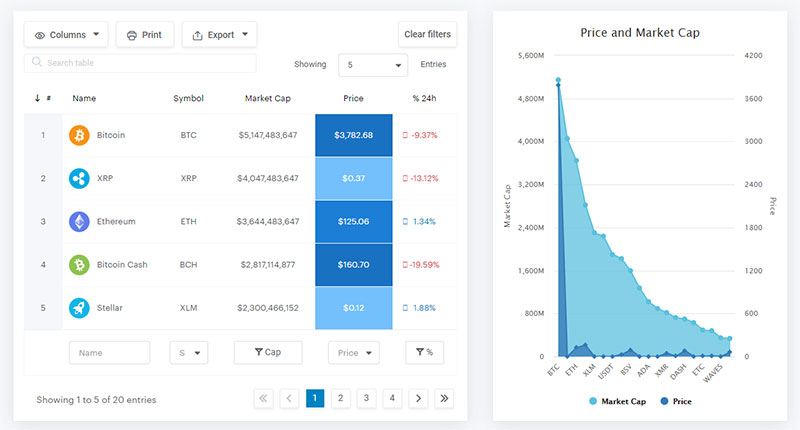
wpDataTables connects straight to MySQL, MS SQL, and PostgreSQL databases and turns live query results into responsive, filterable tables. That’s the whole pitch, really: point it at a database once, and the table keeps itself current instead of you re-pasting numbers every week. Nothing else on this list handles that kind of live SQL connection quite as directly.
It’s built for agencies and site owners juggling large, constantly-changing datasets that live outside WordPress, not for a one-off list of five products.
It pulls from a wide range of sources:
- Imports from MySQL, MS SQL Server, PostgreSQL, Excel, CSV, and Google Sheets
- Conditional formatting and inline frontend editing
- Chart rendering through Chart.js, Google Charts, or Highcharts
- Server-side processing for tables running into the thousands of rows
The free version on WordPress.org caps out around 150 rows per table and skips manual table creation, so most people end up on a paid tier fairly fast. Premium starts at $69/year for a single site and tops out at $249/year for the unlimited-site Developer license, backed by a 15-day refund window (wpDataTables, 2026).
A few things make it worth the setup time:
- Handles genuinely large datasets without the page grinding to a halt
- Charts and tables share the same data source, so nothing gets out of sync
- Frontend editing means clients can update rows without touching wp-admin
It’s not without friction, though:
- The free tier’s row cap and lack of manual tables push most real use cases toward premium
- The database-connection features have a setup curve non-technical users will feel
Most table plugins treat “data source” as a CSV upload. wpDataTables treats it as a live connection, and that’s really the gap between a table that just displays and a tool built for actual reporting. The small stuff shows it too, like the built-in table footer row that auto-sums or averages a column: the kind of detail that only turns up once you’ve built a real reporting table instead of a demo one.
TablePress: best for free, general-purpose tables
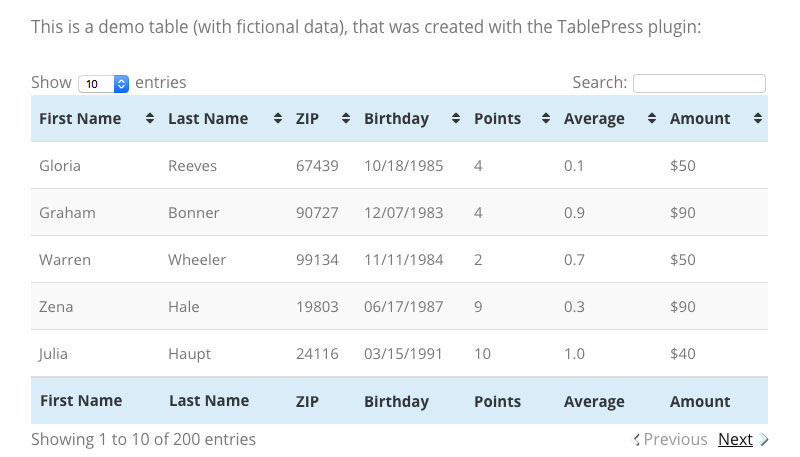
TablePress is free, has no row limits on its core version, and has racked up more than 600,000 active installs, which alone tells you it’s the default choice for a lot of people who just need a solid table without picking a paid plan first. It skips database connections entirely and sticks to a spreadsheet-style editor instead.
That makes it the pick for bloggers and small sites that want unlimited free tables without touching a database, built around an Excel-style editing grid that stays free forever with no artificial caps on rows or tables.
The backend covers the basics well:
- Spreadsheet-style backend editing, no HTML required
- Import and export in Excel, CSV, HTML, and JSON formats
- Shortcode, Gutenberg block, and Elementor widget embedding
- DataTables.js-powered sorting, search, and pagination
Core features cost nothing. Pro runs $89/year and Max runs $189/year per site, and lifetime licenses are available too, at $389 and $789 (TablePress, 2026).
There’s a real case for sticking with the free version alone:
- No row or table limits on the free version, a rarity in this category
- Familiar spreadsheet interface with almost no learning curve
- Backed by nearly two decades of updates and a large support community
A couple of gaps stand out:
- Responsive tables that reflow on mobile sit behind the paid Pro plan, not the free version
- No built-in chart or graph maker; you’ll need a separate plugin for that
TablePress’s own install count, more than 600,000 active sites as of 2026, is one of the few plugin-adoption figures in this category that comes straight from the developer’s dashboard rather than a marketing claim. And the free-forever core really is unrestricted on rows and tables, which is rare. Most “free” table plugins gate mobile responsiveness or row counts somewhere; TablePress only gates styling convenience.
Ninja Tables: best for WooCommerce product tables

Ninja Tables pairs a drag-and-drop builder with a WooCommerce integration built specifically for turning a product catalog into a searchable, filterable table. If you’re running a WooCommerce store and want something better than the default shop grid, this is the most direct route from “products in WooCommerce” to “table on the page.”
The live Google Sheets sync is the other half of the pitch, paired with a purpose-built WooCommerce product table mode: edit the spreadsheet, and the table on your site updates without a manual re-import.
Beyond that, it covers:
- Live Google Sheets sync, so spreadsheet edits appear without a manual re-import
- Drag-and-drop column and row reordering
- Conditional formatting for highlighting cells, rows, or columns
- Chart builder (Ninja Charts) using the same table data
The free version on WordPress.org handles standard tables, styling, and basic filtering just fine. Pro starts at $49/year for a single site and is what unlocks the WooCommerce tables and Google Sheets sync (BloggingWizard, 2026).
It holds up well even outside its WooCommerce niche:
- Free version is capable enough for most non-eCommerce table needs
- WooCommerce integration is purpose-built, not bolted on
- Google Sheets sync removes manual re-uploads for teams already living in spreadsheets
The catch is where the good stuff sits:
- Google Sheets sync and WooCommerce tables both require the Pro upgrade
- No native database (MySQL/SQL) connection the way wpDataTables offers
Ninja Tables markets itself pretty directly as a wpDataTables alternative for teams that want WooCommerce and Sheets integration without setting up SQL, and that framing actually tracks with what the free version covers. It’s the one plugin on this list built around a single job, product tables for WooCommerce, instead of trying to be a general-purpose data manager.
WP Table Builder: best for drag-and-drop pricing tables
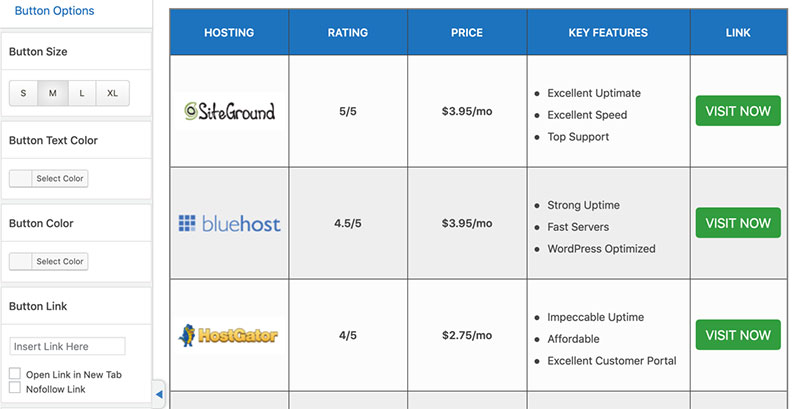
WP Table Builder skips spreadsheet-style editing altogether and gives you a real drag-and-drop canvas instead, built around seven cell elements: text, image, list, button, star rating, custom HTML, and shortcode. Affiliate marketers building visual comparison and pricing tables by hand tend to gravitate toward it, less so anyone managing large datasets.
What you actually get:
- Seven drag-and-drop cell elements, including star ratings and custom HTML
- Cell management mode for merging, splitting, adding, and removing rows or columns
- CSV and XML import, including bulk zip-file imports
- Per-device responsive controls, not just a single mobile breakpoint
The free version includes all seven core elements and unlimited tables. Starter Pro runs $39.99/year for a single site, with higher tiers available for more sites (WPism, 2026).
A few reasons it’s worth the switch from a spreadsheet grid:
- Visual builder makes cell-level design changes fast, no CSS required
- Per-device responsive mode gives real control over the mobile layout
- Existing tables carry over cleanly when you activate the Pro add-on
It’s not built for everything, though:
- Not built for large, dynamic datasets the way wpDataTables is
- Active installs sit around 50,000 on WordPress.org, smaller than category leaders like TablePress or Ninja Tables, worth weighing if a bigger support community matters to you
The cell-level drag-and-drop workflow does speed up building something small and visually specific, like a five-row pricing comparison, compared to fighting spreadsheet cell settings one by one. It’s also the only plugin here where the editor itself, not just the output, is drag-and-drop, which matters if you think in visuals rather than rows and columns.
RioVizual: best for Gutenberg comparison and pros/cons boxes

RioVizual is a native Gutenberg block plugin built specifically for comparison tables, pricing tables, and pros and cons boxes rather than general data tables. If your site publishes a lot of “X vs Y” posts and buying guides, its dedicated comparison table block, with built-in pros and cons schema markup, is built for exactly that.
It ships with:
- 25 pre-designed pricing table templates (RioVizual, 2026)
- Dedicated pros and cons block with schema support
- Responsive column controls per breakpoint
- Native Gutenberg block, no shortcodes needed
Free on WordPress.org gets you the core table builder plus the pricing table and pros/cons blocks. Premium tiers add more templates, elements, and priority support (RioVizual, 2026).
What sets it apart:
- Purpose-built for content-page tables, not repurposed from a data-table tool
- Schema markup on pros/cons boxes is a real SEO detail most table plugins skip
- Fully native to the block editor, no separate builder screen
The trade-off is scope:
- Not designed for large, database-backed datasets
- Value depends heavily on how content-table-heavy your site actually is
The 25 built-in pricing table templates cut out the “start from a blank table” step that slows down most comparison-table builds. And most table plugins treat pros/cons boxes as an afterthought. RioVizual ships schema markup for them out of the box, which the others simply don’t.
Tableberg: best for Gutenberg-native block tables

Tableberg extends WordPress’s native Table block instead of replacing it, adding sub-blocks like buttons, images, lists, and ratings you can drop straight into cells without leaving the Gutenberg editor. It’s for anyone who wants richer tables but doesn’t want to learn a whole separate builder interface.
On top of the core block, it adds:
- Cell merging and alignment controls inside the block editor
- Prebuilt templates spanning several types of data tables, from pricing to team member listings
- Responsive controls per device
- Lightweight footprint, since it extends the core block rather than replacing it
There’s a free version on WordPress.org. Pro runs roughly $49/year for a single site (WP Table Builder resource, 2025).
It feels native for a reason:
- Feels native, since it’s an extension of core Gutenberg rather than a bolt-on plugin UI
- Lightweight compared to full drag-and-drop builders
- Template range covers pricing, comparison, team, and schedule tables
Worth weighing before you commit:
- Newer plugin with a smaller track record than TablePress or wpDataTables
- Advanced sub-blocks and templates require the Pro upgrade
Because it builds on the core Table block instead of replacing the editing experience, existing default-table content converts into Tableberg tables without a rebuild. It’s probably the clearest example on this list of a table plugin designed around Gutenberg’s block model first, rather than ported over from an older shortcode-based plugin.
Data Tables Generator by Supsystic: best for dynamic tables with built-in charts
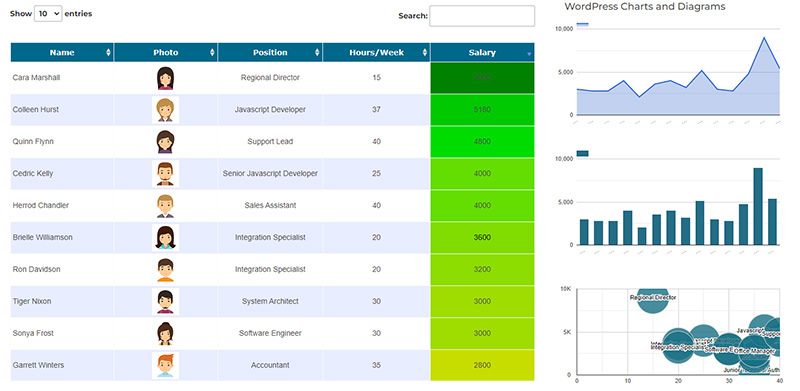
Data Tables Generator pairs table creation with charts and graphs pulled from the same dataset, plus row-level extras like a table with collapsible rows option for long datasets. It sits in a reasonable middle ground between TablePress’s simplicity and wpDataTables’ database depth, without a full SQL connection.
It covers:
- Responsive modes that rebuild column layout per screen size
- Formula and HTML support inside cells
- Import and export via CSV, Excel, PDF, and Google Sheets
- Frontend table editing on the premium tier
Free on WordPress.org covers manual tables, sorting, and basic charts. Premium unlocks through an annual or lifetime license, including a bundle covering Supsystic’s full plugin lineup (Supsystic, 2026).
The upside:
- Charts and tables share a data source, so updates stay in sync
- Collapsible rows help long tables stay scannable without pagination
- Formula support inside cells is unusual at this price point
The downside:
- Frontend editing and advanced filtering both sit behind the premium tier
- Interface feels dated next to newer block-based builders like Tableberg
A customer testimonial on Supsystic’s own site describes importing a product catalog from Google Sheets and getting filters running in under an hour, and that lines up with how quickly the spreadsheet-import flow actually runs (Supsystic, 2026). Collapsible rows sound like a small feature, but they solve a real problem: long tables that need to stay readable without forcing every visitor through pagination.
Posts Table Pro: best for turning WordPress content into a table

Posts Table Pro doesn’t manage outside data at all. It converts your own posts, pages, and custom post types into searchable, sortable tables automatically, which makes it the right tool for document libraries, staff directories, and catalogs built from posts or custom post types you already have, rather than data living in a spreadsheet somewhere.
It handles:
- Lists posts, pages, custom post types, and custom fields as table rows
- AJAX search and column-level ascending/descending sort
- Adjustable table pagination, letting visitors choose rows per page
- Media columns for audio, video, and image galleries inside the table
There’s no free version. Starter costs $89/year for one site, Business runs $159/year, and Agency is $319/year, each step up unlocking more site licenses (Kinsta, 2026).
What it gets right:
- Zero manual data entry once your content structure is set up
- AJAX search feels fast even on tables with hundreds of rows
- Custom field support means it adapts to almost any content type
What it doesn’t:
- No free tier to test before buying
- Pricing is steep next to plugins built for manually entered data
Because it reads directly from the post database, updating a product’s price or a document’s file just means editing the post. The table reflects it automatically, no re-import step needed. It solves a genuinely different problem than everything else on this list: turning content you already publish into a table, instead of importing outside data into one.
Flexible Table Block: best for free cell merging in Gutenberg

Flexible Table Block is completely free and open-source, and it does one thing well: merging and splitting table cells, with none of it locked behind a premium gate. If you just want core WordPress tables with real formatting control, this is the pick.
It includes:
- Merge and split cells from multiple selections, covered in detail in this guide on how to merge cells in HTML
- Individual styling per table tag, cell, and caption
- Horizontal scroll on desktop, vertical stacking on mobile, with adjustable breakpoints
- Batch cell selection for faster row and column edits
It’s entirely free, with no premium tier or paid add-on at all (Flexible Table Block, 2026).
The appeal is straightforward:
- No feature-gating at all, rare in this category
- Lightweight, since it extends the native block rather than replacing the editor
- Clean HTML output, without extra div wrappers bloating the markup
The limits are just as straightforward:
- No dynamic data sources, sorting, or filtering; it’s a formatting tool, not a data manager
- Styling configuration deviates from typical WordPress patterns, which adds a small learning curve
Developer reviews keep pointing to the same detail: it does merging and splitting well without nagging anyone toward a premium upgrade, which is unusual for a plugin in this space. It’s proof that cell merging, normally a paid feature everywhere else on this list, doesn’t have to be gated behind a paywall.
ARPrice: best for standalone pricing tables

ARPrice skips general data tables entirely and focuses on one thing: pricing tables, with page-builder integration and A/B testing built in. It’s aimed at SaaS and service sites that need a dedicated pricing page tool rather than a table plugin repurposed for pricing.
It brings:
- Integrates with Elementor, Beaver Builder, WPBakery, Divi, and Cornerstone
- Over 2,000 font icons and hundreds of Google Fonts for styling
- Export and import tables between sites
- Draws on a library of pricing table examples as starting templates
The free version only works with the Gutenberg editor and comes with limited features. Premium costs $27 on CodeCanyon, which includes six months of support, extendable for an extra fee to cover a full year (ProfilePress, 2026).
In its favor:
- A/B testing is a genuinely rare feature at this price point
- Broad page-builder compatibility beyond just Gutenberg
- Cross-site export/import saves rebuilding tables from scratch
Against it:
- Free version is Gutenberg-only, which limits it if you use a different builder
- Some users report the frontend builder feels laggy on larger pricing grids
The PayPal integration and A/B testing combination is aimed squarely at conversion, not just table display, and it shows in how the settings panel is built around plans and calls to action rather than rows and columns. It’s the only plugin here that treats a pricing table as a conversion tool first and a table second, right down to the built-in split testing.
What Is a WordPress Table Generator Plugin?
Take data, whether typed in by hand or pulled from an outside source, and turn it into a sortable, filterable table on a page or post: that’s the entire job description for wpDataTables and every plugin like it, just handled with different amounts of depth.
A table generator plugin isn’t the same thing as the native Gutenberg table block, which only stores static text in a grid. There’s no sorting, no external data pull, and charts aren’t part of the deal either.
Every table these plugins render still comes down to standard HTML tables under the hood, just styled and enhanced with JavaScript on top.
The category basically breaks down into a handful of table types worth knowing:
- Manual tables: data typed directly into the plugin’s editor, no external source
- Editable tables: rows that site owners or visitors can update from the frontend
- Responsive tables: layouts that reflow, stack, or scroll on smaller screens
WordPress runs 41.2% of all websites tracked globally as of August 2026 (W3Techs, 2026), and that’s the scale that makes a dedicated table plugin category worth building for in the first place.
wpDataTables’ free version alone counts over 70,000 active installs on the WordPress.org repository (WordPress.org, 2026), on top of whatever runs through its premium licenses.
How Do WordPress Table Plugins Connect to Data Sources?
Some table plugins import your data once and leave it alone after that. Others stay hooked into the source and refresh automatically, and the difference decides whether you’re maintaining a table by hand every week or letting the source file do that work for you.
| Source type | Connection style | Updates when source changes |
|---|---|---|
| CSV / Excel upload | One-time import | No, requires re-upload |
| Google Sheets | Live API connection | Yes, on refresh or sync |
| MySQL / MS SQL / PostgreSQL | Direct query | Yes, on page load |
Most plugins in this category cover the same core list of data sources: CSV, Excel, XML, JSON, Google Sheets, and one or more SQL databases.
Database-backed plugins go a step further. wpDataTables, for instance, documents exactly how to fetch data from a database in a WordPress page, which is what lets a table reflect a live MySQL query instead of a frozen snapshot.
Google Sheets lands somewhere in the middle. Plugins that support it can visualize Google Sheets data without touching a database at all, which is handy for teams that already track inventory or pricing in a spreadsheet.
Sorting and filtering on the frontend usually isn’t custom-built per plugin, either. Most WordPress table tools sit on top of the same jQuery library, DataTables.net, which BuiltWith currently counts on 475,205 live websites (BuiltWith, 2026). That shared foundation is why sorting, search, and pagination tend to behave almost identically across different table plugins, even when the branding and pricing don’t.
How Do These Plugins Turn Tables into Charts?
Chart generation works by pointing a charting library at the same dataset that already feeds the table, rather than building the chart from scratch. Change a row in the table and the chart redraws from the same numbers, no separate chart tool required.
A few libraries show up again and again:
- Chart.js, canvas-based, lightweight, MIT-licensed
- Google Charts, hosted by Google, broad chart-type coverage
- Highcharts, commercially licensed, more advanced styling controls
Chart.js is the one most table plugins default to. It draws over 50 million npm downloads a month, ahead of every other dedicated JavaScript charting library by that measure (npm registry download data, 2026).
That popularity isn’t incidental to WordPress table plugins specifically. It comes down to Chart.js being free, small enough that it doesn’t slow a page down, and simple enough to configure without writing much code, all things that matter to a plugin trying to stay lightweight.
Google Charts and Highcharts both trade some of that simplicity for more built-in chart types and finer styling control, which is why plugins built for enterprise or data-heavy sites tend to support one or both alongside Chart.js rather than instead of it.
FAQ on WordPress Table Generator Plugins
Is a table plugin different from a page builder’s built-in table widget?
Page builder table widgets, the kind you find in Elementor or Divi, style manually entered content but rarely connect to external data sources, sorting, or search. A WordPress table generator plugin like wpDataTables adds live data imports, filtering, and chart integration on top of that.
Can you edit a WordPress table directly from the frontend?
wpDataTables and Ninja Tables both support frontend editing, letting logged-in users or visitors update table rows without ever opening wp-admin. Free versions usually restrict editing to the backend though, so it’s worth confirming the plugin’s Pro tier before you rely on it.
The First WordPress Table Plugin Worth Installing
wpDataTables is the plugin worth installing first when a table needs to pull from a database, Excel file, or Google Sheet, since plugins built only for manual entry can’t maintain that same live connection.
Getting the setup right without wasting time on trial and error usually comes down to:
- Matching the free tier to your actual data source
- Testing the responsive layout before scaling up rows
- Upgrading once row counts or database queries demand it
wpDataTables’ free listing counts more than 70,000 active installs, and its Basic premium license starts at 69 dollars a year, a lower entry point than Posts Table Pro’s 89-dollar, no-free-tier license.
Real column layouts, footer totals, and chart pairings show up clearest in the collected examples of data tables, which is a reasonable next stop once you’ve settled on which plugin to install.