Forty responses land in a spreadsheet and just sit there. Rows and columns, no shape to any of it yet. A survey graph maker takes that raw pile of poll, quiz, or form answers and turns it into something a reader can actually take in at a glance, a bar chart, a pie chart, or a line showing a metric moving over time.
WordPress site owners and market researchers run these tools constantly, and plenty of internal HR teams do too. What they’re really judging, whether they say it out loud or not, is speed. How fast does a submitted answer turn into something you can screenshot and drop into a slide.
wpDataTables’ add-on for Forminator handles that rendering through four separate engines: Google Charts, Chart.js, HighCharts, and ApexCharts. That’s documented directly in the plugin’s own integration spec.
Table of Contents
Best survey graph maker tools, ranked
Turning a stack of poll and quiz answers into something a reader can scan in five seconds is really the whole point of visualizing survey data in the first place. The list below runs best first, and the ranking comes down to one thing: how directly a tool gets you from a submitted answer to a finished chart, not just a table full of numbers.
1. wpDataTables (with Forminator integration), best for WordPress sites turning survey, poll, or quiz submissions into charts
wpDataTables is a WordPress table and chart plugin, and its Forminator add-on pulls poll, quiz, and form entries straight into a chart wizard. If you’re already running surveys through Forminator and want more than a wall of submissions, this is the strongest pick on the list.
The part worth knowing about is the dedicated Forminator Form table type. It rebuilds itself automatically as responses come in, so there’s no manual export step sitting between a new answer and an updated chart.
- Reads poll, quiz, and form entries directly from Forminator, no CSV export needed
- Renders through four different chart engines: Google Charts, Chart.js, HighCharts, or ApexCharts
- Filters entries by date range or entry ID before they hit the chart
- Supports bar and pie output for the same poll, side by side
Pricing: there’s a limited free version on WordPress.org. The premium plugin starts at roughly $42 per year for a single-site license (Blogging Wizard, 2026), and the Forminator integration itself doesn’t cost extra. It’s a free add-on available on both the free Lite and paid Premium versions of wpDataTables. That’s not true of every integration wpDataTables offers; Gravity Forms and Formidable Forms are sold as separate premium add-ons.
No coding needed to wire a live Forminator poll into a chart, and the same table can throw off both a bar chart and a pie chart from one dataset. It also plays nice with WooCommerce, Elementor, Divi, and WPBakery right out of the box.
On the downside, HighCharts and ApexCharts sit behind the Standard premium tier or higher, so the entry-level plan doesn’t get every chart style. There’s no free trial either, just a 15-day money-back guarantee on premium purchases (wpDataTables, 2024). And honestly, the number of settings tabs makes this slower to learn than a plain form-results table, worth knowing going in.
The plugin’s own documentation walks through building a full survey results table from Forminator poll entries step by step, shortcode included. Its add-on page also lists real-time chart updates as new form entries arrive, plus a choice of four rendering engines rather than one fixed style (wpDataTables, 2025). Most survey tools stop at a results table. This is one of the few that lets the same poll data drive a bar chart, a pie chart, and a filtered table at once, without re-entering anything.
| Chart engine | Available on | Good fit for |
|---|---|---|
| Google Charts | All premium tiers | Fast, familiar bar and pie charts |
| Chart.js | All premium tiers | Lightweight, animated charts |
| HighCharts | Standard tier and up | Polished, presentation-ready visuals |
| ApexCharts | Standard tier and up | Modern, interactive tooltips |
2. SurveyMonkey, best for teams that want distribution and analytics in one place
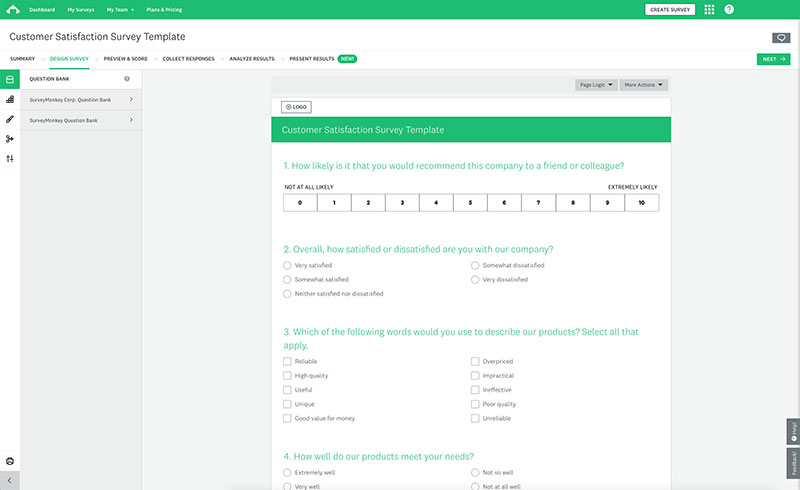
SurveyMonkey is a standalone platform, not a plugin, which matters if you don’t want to touch a CMS at all. Build the survey, send it, watch the chart update, all inside one tool. That makes it especially practical for teams running customer satisfaction surveys, where collecting responses and reviewing the resulting trends in the same platform saves an extra reporting step.
HR teams reach for it a lot, and so do market researchers and customer feedback groups, mostly because the distribution channels come built in rather than bolted on afterward.
- Analytics dashboards chart results automatically as responses arrive, no separate charting step tacked on
- Template coverage spans NPS, CSAT, and general market research categories
- Integrations into Salesforce and Tableau for teams doing anything downstream with the data
- Sentiment analysis on open-ended responses, but only on the Team Premier tier
Pricing: the free plan tops out at 10 questions and a small number of viewable responses, not exactly built for a real survey. Advantage Annual runs about $39 a month billed annually for one user (SurveyMonkey pricing sources, 2026), and once that free cap gets hit, response overages bill automatically. Team plans also require a three-user minimum, which pushes the real entry cost higher than the sticker price suggests.
SurveyMonkey’s free Basic plan really is capped at 10 questions per survey and a limited number of viewable responses, which tends to push active users toward the paid tier within a single survey cycle (SurveyMonkey pricing sources, 2026). Still, it’s one of the few tools that pairs distribution (email, embed, link) with charting inside the same dashboard, so there’s no export step wedged between collecting answers and actually seeing a graph.
3. Typeform, best for conversational, one-question-at-a-time surveys
Typeform shows one question per screen instead of a long grid, and that format alone tends to keep people finishing the survey rather than bailing halfway through. Marketing teams running short surveys on a landing page, where completion rate matters more than raw question count, gravitate toward it for exactly that reason.
Responses can also be collected from campaigns driven by an email marketing service, giving teams another way to send people directly into a short, mobile-friendly questionnaire.
- Logic jumps change the next question based on a prior answer
- Built-in results summary with basic per-question charts
- Video or image-based question types available when a plain text field feels too flat
Pricing: as of February 2026 the free plan collects only 10 responses a month, down from the 100 it used to allow, a 90% cut. Paid plans start around $28 to $29 a month billed annually (Typeform pricing trackers, 2026). Typeform’s own pricing history backs this up: the free-tier cap dropped from 100 to 10 responses per month in February 2026, a change pricing trackers flagged as one of the sharpest free-tier cuts of the year (GetPricePulse, 2026).
What you get is a genuinely clean, mobile-friendly format and branching logic without writing any code. What you don’t get is deep chart customization, it’s thinner here than in tools built specifically around data visualization. And the free tier, at this point, reads more like a demo than something you’d actually run a survey on.
Still, the one-question-at-a-time approach changes the shape of the data you end up with before a single chart even gets built, which is a genuinely different starting point than most competitors offer.
4. Google Forms, best for free surveys with basic charts already built in
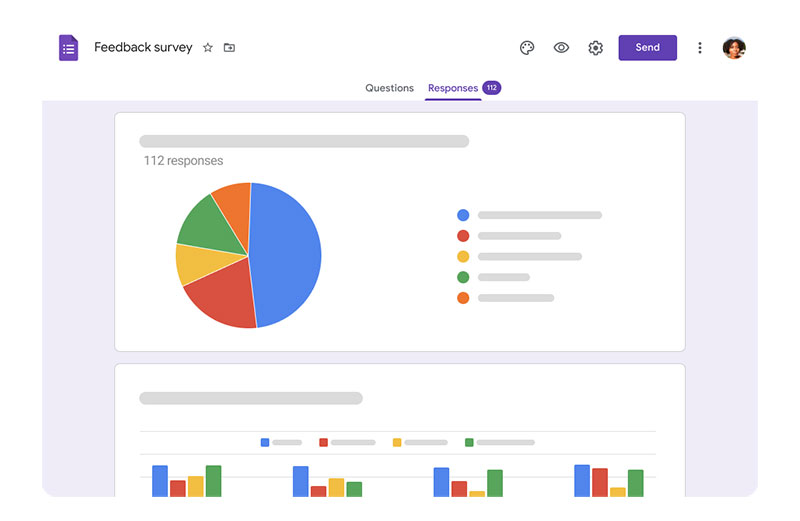
Google Forms is free, tied to Sheets, and probably the first tool most people try. No login beyond a Google account, no separate charge, unlimited responses on the free plan.
The Summary tab is the standout piece here. It turns multiple-choice and checkbox answers into bar and pie charts the moment responses start coming in, automatically, without touching a chart builder.
- Live sync to Sheets for anyone who wants to dig further
- Question types cover multiple-choice, checkbox, and linear scale
Chart types stay limited to a handful of basic formats, and styling control is close to nonexistent. Teams outgrow the built-in Summary charts fast, which is exactly why so many searches revolve around turning a Google Forms results graph into something more customizable once the default bar chart stops cutting it.
It’s the baseline nearly everyone tries first. Free, fast, already wired into Sheets, before anyone decides whether they actually need more control over how the chart looks.
5. Jotform, best for teams that need survey tables, payments, and workflow automation together
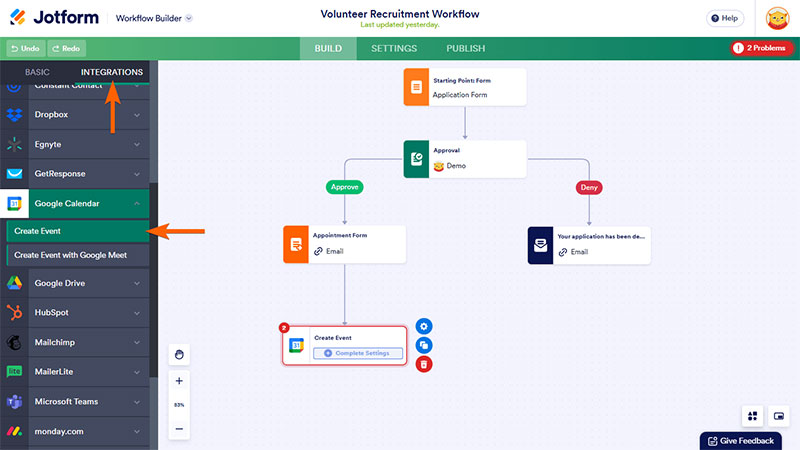
Jotform pairs surveys with payment collection and light workflow automation, which matters if a form needs to do more than just collect answers. Service businesses and event organizers running surveys alongside payments or signups tend to land here.
- Built-in report builder turns submissions into visual summaries without leaving the platform
- Template library runs past 10,000 layouts, including ones built specifically for surveys
- Native payment collection through PayPal, Stripe, and Square
- Conditional logic on individual fields
Pricing: the free Starter plan caps out at 5 forms and 100 submissions a month. Bronze starts around $34 a month billed annually (FormNX, Automation Atlas, 2026). That cap is easy to hit fast: Jotform’s own free Starter plan limits accounts to 5 forms and 100 monthly submissions, and active lead-capture or research forms typically exceed that within days (FormNX, 2026).
HIPAA compliance sits behind the Gold tier, worth flagging if that matters for your use case. But for surveys that also need to collect a fee or a signature, folding all of that into one tool cuts out a second integration most competitors would require.
6. Qualtrics, best for enterprise research teams needing advanced statistical analysis
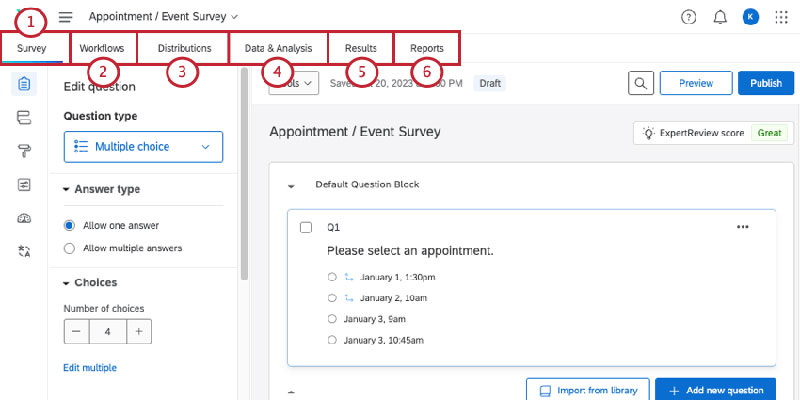
Qualtrics sits a level above the rest of this list. It’s built for organizations running large studies that need statistical rigor behind every chart, not just a visual that looks convincing.
- Cross-tabulation and significance testing built in
- Enterprise-grade permissions and data governance
- Wide integration library covering CRM and data warehouse tools
- Regression and driver analysis layered directly on top of the charting engine
Pricing: there’s no published flat pricing here. Quotes get built around seats, response volume, and which modules a team needs. That opacity makes budgeting without a sales call genuinely difficult, and for a single department running occasional polls, this is overkill. Qualtrics counts more than 13,000 brands as customers, according to the company’s own product listing.
What you’re paying for is statistical depth well beyond basic chart-and-export tools, plus audit trails that matter once a survey chart needs to support an actual business decision rather than just illustrate one.
7. Zoho Survey, best for small businesses already running the Zoho suite
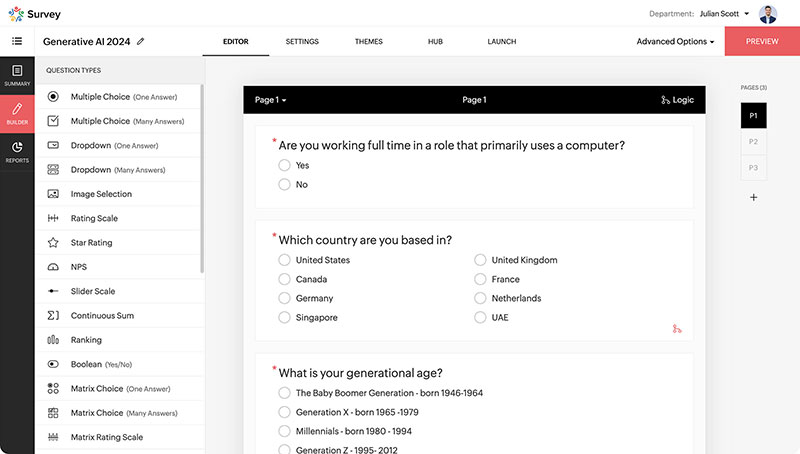
Zoho Survey lives inside the wider Zoho ecosystem, and it’s really built for teams already running Zoho CRM or Zoho One who want survey charts sitting in the same account as everything else.
- Data flows directly into Zoho CRM and Zoho Analytics
- Real-time reporting dashboard covers filtering and cross-tabs
- Skip logic and question piping available
- Native integration with the rest of the Zoho product line
Pricing: a free plan exists with limited responses and questions. Paid tiers get billed separately or folded into wider Zoho One pricing depending on which modules a business already owns.
Setup friction stays low for existing Zoho customers, and charts plus raw data both live inside Zoho Analytics for deeper cuts later. Outside the Zoho ecosystem though, it’s a lot less appealing on its own, and the templates trail more design-forward competitors by a fair margin.
Its main selling point in independent roundups is really the tight loop between survey responses and Zoho’s CRM and analytics products, more than any single standout chart feature. For a business already paying for Zoho, it removes the cost and setup of a separate charting tool entirely.
8. Microsoft Forms, best for organizations standardized on Microsoft 365 and Excel
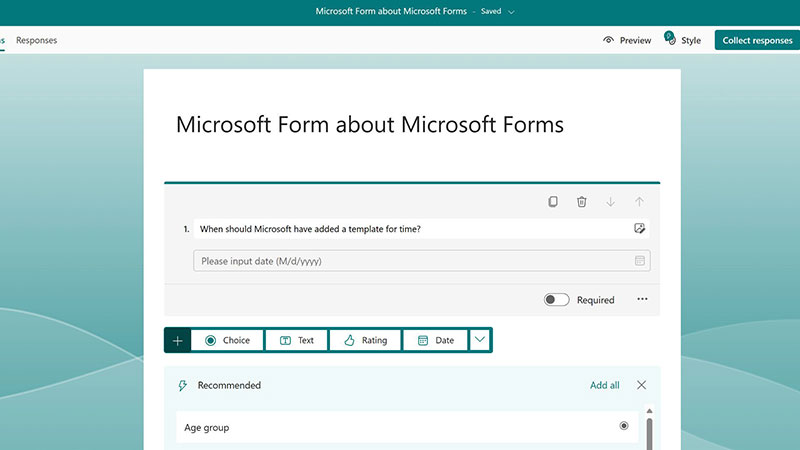
Microsoft Forms comes built into Microsoft 365, and for organizations already living in Excel and Teams, that means charts without a new login to remember.
- One-click export for raw responses and an auto-generated summary chart straight into Excel
- Tight integration with Excel and Teams for collaboration
- Automatic summary charts per question, similar to Google Forms
- Branching logic on both quiz and survey questions
Pricing: included with Microsoft 365 Education, Business, and Enterprise subscriptions, no separate charge for the form tool itself. No new account is needed for existing Microsoft 365 users, and the Excel-based export gives a familiar path to deeper chart customization.
Chart styling inside Forms itself stays basic though, and it’s not available as a true standalone product outside Microsoft 365. Independent 2026 survey-tool comparisons keep flagging the Excel and Teams integration, not native charting depth, as the reason organizations pick this over a dedicated survey platform. For anyone already paying for Microsoft 365, it’s effectively a free add-on for turning survey answers into an Excel-ready chart.
9. QuestionPro, best for market researchers needing advanced logic and NPS tracking
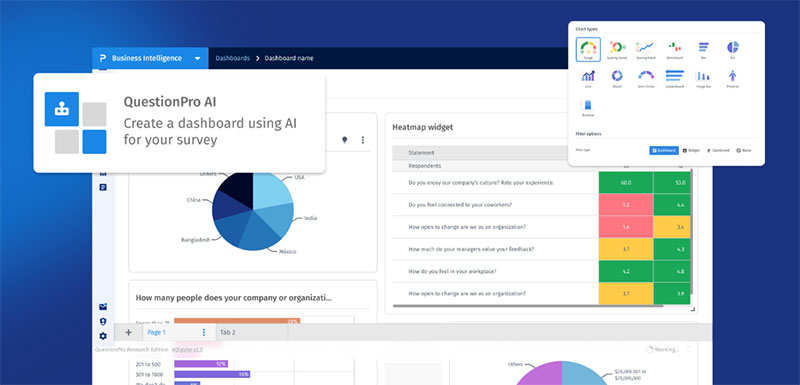
QuestionPro leans research-first. Market research and CX teams tracking recurring metrics like NPS over time tend to end up here rather than on a general-purpose form builder.
- Purpose-built NPS and CX dashboards chart trend lines automatically as new responses land
- Advanced skip and branch logic for long research surveys
- Dedicated NPS and CX tracking modules built in
- Offline survey collection with later sync, for field research where connectivity isn’t guaranteed
Pricing: a free plan exists with limited responses and questions. Paid research and CX plans get quoted based on the modules and response volume a team actually needs.
This is genuinely built for recurring metrics rather than one-off polls, and offline collection is a real differentiator for anyone doing field research. That said, the interface feels denser than lighter tools like Google Forms or Typeform, and the full CX feature set is priced for research teams, not casual users.
2026 survey software roundups consistently place it in the research and CX category rather than general-purpose form builders, which tracks with the dashboard-first design. It treats a chart as part of an ongoing metric to track, not a one-time snapshot, which matters for anyone running the same survey quarter after quarter.
10. Datawrapper, best for publication-ready charts built from already-exported survey data
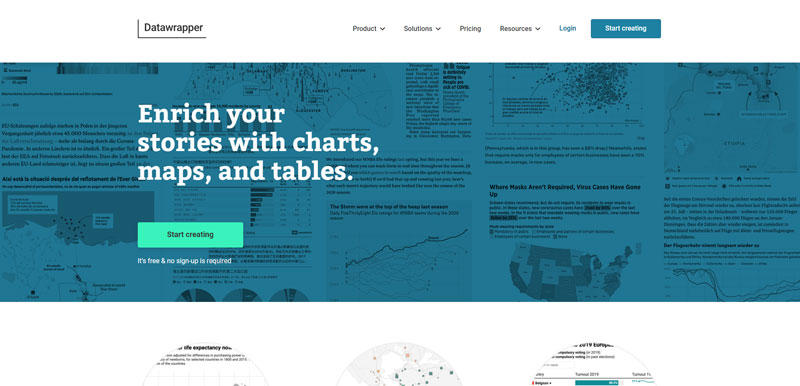
Datawrapper doesn’t collect survey responses at all. It’s a chart-first tool built for taking an already-exported dataset and turning it into something clean and embeddable for an article or report.
Newsrooms, communications teams, and analysts who already have results sitting in a spreadsheet reach for it when they need a polished chart fast.
- Data pastes in from CSV or Excel
- Editorial-grade styling and annotation tools
- Embed code responsive enough to hold up on nearly any website, not just a dashboard
Pricing: a free plan covers basic charts. Paid plans add custom branding, more chart types, and team accounts, priced per seat.
Charts look publication-ready without extra design work, which is genuinely fast once the data’s already exported. The tradeoff is there’s no survey or form builder attached, it only charts what someone else already collected, and that manual export step from whatever tool actually ran the survey is unavoidable.
Its positioning across data journalism and newsroom toolkits centers almost entirely on chart polish and embed reliability, not survey collection, since it doesn’t collect responses at all. When a survey tool’s own charts aren’t good enough for a report, this tends to be what finishes the job rather than replaces the collector.
What is a survey graph maker
Two different things get lumped under this term, and the distinction actually matters for picking a tool. Some platforms both collect responses and chart them, no export step in between. Others only chart data that’s already been collected somewhere else, CSV in, chart out.
- Collector and charting tool combined: the survey platform itself renders the chart, no export needed
- Charting tool only: the survey data gets exported first, then pasted or uploaded into a separate charting tool
The category sits inside the wider data visualization space, but narrower. It exists specifically for response data, not financial, scientific, or operational datasets the way a general BI tool would handle.
What types of charts do survey graph makers produce
There’s real research behind why bar charts dominate this category. Readers judge bar lengths far more reliably than they judge pie chart angles or areas, a finding that goes back to Cleveland and McGill’s original perceptual studies from the 1980s. That single result shapes most of the chart type decisions these tools make by default.
Visualizing survey data clearly starts with matching the chart format to the question and the comparison readers actually need to make.
- Bar charts handle comparisons across more than three answer options best
- Pie and donut charts stay readable for two to four categories, and get weaker fast beyond that
- Line charts track a metric like NPS or satisfaction score across survey waves over time
- Stacked bar charts show how a breakdown, region or age group, shifts within each answer
Most survey graph makers default to bar or pie chart output for multiple-choice questions, since those formats map cleanly onto that question type. Donut charts show up almost as often too, though mostly as a stylistic variant of the pie chart rather than anything functionally different.
What to look for before choosing a survey graph maker
Four things end up deciding whether a survey graph maker actually fits a workflow, and price isn’t even first on the list.
Whether the tool reads your existing form or survey data natively matters more than almost anything else.
If every chart requires a manual CSV import first, that’s friction you’ll hit every single week, especially when running a recurring pulse survey where fresh responses need to reach the reporting layer quickly. Customization depth comes next, since a locked default style gets old fast once a chart needs to match a report or a client deck.
Then there’s how the chart behaves after publishing: does it rebuild itself as new responses roll in, or does it freeze the moment you hit export. And finally, whether the finished chart can actually leave the platform, as a shortcode, an embed, or something other than a screenshot.
Heavier analytics platforms like Tableau or Power BI check all four boxes, but they’re built for general business data, not specifically survey responses, which is exactly why dedicated survey graph makers still have a place next to them.
Deciding on the right chart type before picking a tool is a good habit too, since not every platform handles every chart format equally well. Tools with interactive charts, hover tooltips, clickable legends, zoomable axes, tend to hold attention longer on a results page than a static image ever will.
How survey response data becomes a chart
The path barely changes from tool to tool. A response gets submitted, the form or survey platform stores it, and a charting layer pulls that data and renders it. What actually differs is how live that connection stays afterward.
Some tools rebuild the chart on every single page load. Others only update on a manual refresh, which sounds like a small difference until you’re staring at a chart that’s a week stale. There’s more on that distinction under real-time data visualization.
Chart rendering engines compared
Chart.js alone pulls something like 10.4 million weekly npm downloads (usedatabrain.com, 2026). That’s one of the most widely used JavaScript charting libraries in production anywhere right now, survey tools included.
| Library | Rendering | Best known for |
|---|---|---|
| Chart.js | Canvas | Simple config, fast setup |
| Google Charts | SVG | Familiar defaults, free hosting |
| D3.js | SVG / DOM | Fully custom, steep learning curve |
| ApexCharts | SVG | Interactive tooltips, modern look |
Most survey graph makers pick one of these engines rather than building a rendering system from scratch, which explains why so many tools end up looking visually similar under the hood. That pattern shows up across javascript chart libraries generally, not just in survey tools specifically.
Data sources these tools can read
Coverage varies more than most people expect going in.
- Native form plugin entries (Forminator, Gravity Forms, WPForms)
- CSV or Excel file uploads
- Live Google Sheets connections
- Direct API or JSON feeds
A tool that only reads CSV files means a manual export every time responses update. One that reads a form plugin directly skips that step completely. The range of data sources a tool supports often predicts long-term convenience better than how many chart styles it ships with on day one.
What the top tools cost and cap
Pulling the numbers together: wpDataTables premium starts around $42 a year for a single-site license (Blogging Wizard, 2026), and the Forminator integration itself doesn’t add to that cost. SurveyMonkey’s free plan caps at 10 questions per survey, with the Advantage Annual tier running about $39 a month billed annually (SurveyMonkey pricing sources, 2026). Typeform cut its free plan from 100 responses a month down to just 10 in February 2026 (GetPricePulse, 2026), which stung a lot of casual users.
Free tiers across this whole category tend to cap one of three things: questions per survey, responses per month, or forms per account. Rarely all three at once, thankfully.
Building your first survey chart, step by step
The sequence barely changes between a plugin-based tool and a hosted platform. Only the setup screens look different.
- Collect enough responses to make a chart worth building, not just a handful of test entries
- Connect the data source, whether that’s a form plugin, a CSV import, or a live spreadsheet sync
- Pick a chart type that actually matches the question format (bar for multi-select, line for trends over time)
- Apply filters, like a date range, before the chart renders so old test data doesn’t skew it
- Adjust colors, legends, and labels to match wherever the chart is going to live
- Embed or publish the chart using a shortcode, iframe, or image export
Skipping the filtering step is the most common reason a first chart looks messier than expected. Stray test submissions and duplicate entries are almost always the culprit.
When a survey graph maker is not the right tool
Most surveys need a margin of error between 4% and 8% at a 95% confidence level to mean much of anything, and hitting that requires an actual minimum sample size, not just whatever responses happened to trickle in (Appinio, 2025).
Charting a survey before you’ve hit that threshold produces a graph that looks precise while resting on numbers too thin to support it.
A pie chart built from 12 responses implies way more confidence than the underlying data actually supports, worth remembering before publishing one. Open-ended, free-text answers resist charting entirely too, they need thematic coding first, not a graph. For a one-off internal survey, say a five-person team check-in, a plain results table is often faster to build and just as easy to read as any chart would be. And when a decision actually needs statistical testing behind it, a chart alone won’t cut it. Charts show a pattern. They don’t prove significance. That’s a job for a platform built around regression and cross-tabulation.
Small sample sizes and cherry-picked chart types are two of the most common sources of misleading statistics in survey reporting, and no charting tool fixes either problem on its own.
FAQ on survey graph maker tools
What’s the difference between a survey graph maker and a plain survey or form builder?
A form builder collects and stores responses in a table, nothing more. What a survey graph maker adds is a rendering step, turning that same data into a bar, pie, or line chart without a separate export or a spreadsheet formula to write.
How many responses do you need before a chart is statistically meaningful?
There’s no universal cutoff here. Most researchers just target a sample large enough to keep the margin of error near 5% at a 95% confidence level, and below that line, a chart is showing you a pattern, not a reliable result.
Do you need coding skills to set up a survey graph maker?
No, not for the basics. Most tools, wpDataTables’ Forminator integration included, run on a point-and-click chart wizard: pick a data source, choose a chart type, publish. Custom styling or a weird data source might still call for some basic CSS or JSON knowledge, but that’s the exception, not the rule.
Can a survey graph be embedded or shared outside the platform that made it?
Yes, and it’s usually painless. Most tools export a shortcode, an iframe, or a static image (PNG or PDF), ready to drop into a separate page, a report, or a client presentation. You can also use a webinar to walk through the results live while keeping the chart embedded in a supporting page or presentation for attendees to reference afterward. No screenshot needed.
Can Google Forms responses be turned into a custom graph automatically?
Automatically, yes, up to a point. Google Forms’ built-in Summary tab charts multiple-choice and checkbox answers on its own, but styling stays limited. Custom colors, filters, or different chart types usually mean exporting to Sheets or connecting a dedicated charting plugin instead.
What’s the right order for evaluating a survey graph maker?
Price should be the last thing you look at, not the first. Platform fit comes before anything else, because a tool that fails that test disqualifies itself before cost ever enters the conversation. Response volume and update behavior come next, and only after both of those hold up does the license price actually matter.
- Platform fit, checked first
- Response volume and update behavior, checked second
- License or subscription price, checked last
Picking wpDataTables with the Forminator integration over a hosted platform trades a yearly license fee for full data ownership and no per-response cap, a trade-off most hosted survey platforms simply don’t offer at any price point.
That same ownership question extends past a single plugin too, which is why it’s worth comparing the wider landscape of WordPress data visualization tools before locking in a stack.