
Plain HTML tables display data. jQuery table plugins turn that data into something people can actually work with.
None of the useful stuff ships by default. Sorting, filtering, client-side pagination, AJAX loading, inline editing, the way columns behave on a phone, you bolt all of it on through a plugin. And pick the wrong one and you’ve signed up for hours of rework.
jQuery still runs on 77.8% of the top 10 million websites (W3Techs, 2025), which means there are millions of developers out there choosing, configuring, and maintaining these tools right now.
So the real question isn’t which plugin is “best” in the abstract. It’s which one fits the thing you’re building, because the right pick for a large-dataset dashboard is the wrong pick for a mobile-first layout, a Bootstrap project, or a CRUD admin panel. That’s what the rest of this works through: what each plugin genuinely does well, where it falls down, and how to match it to your project.
Table of Contents
The Best jQuery Table Plugins
Pick wrong here and you spend hours configuring features you don’t need, or you hit a wall when the project grows.
Here’s what each plugin actually does well, where it falls short, and when to use it.
DataTables
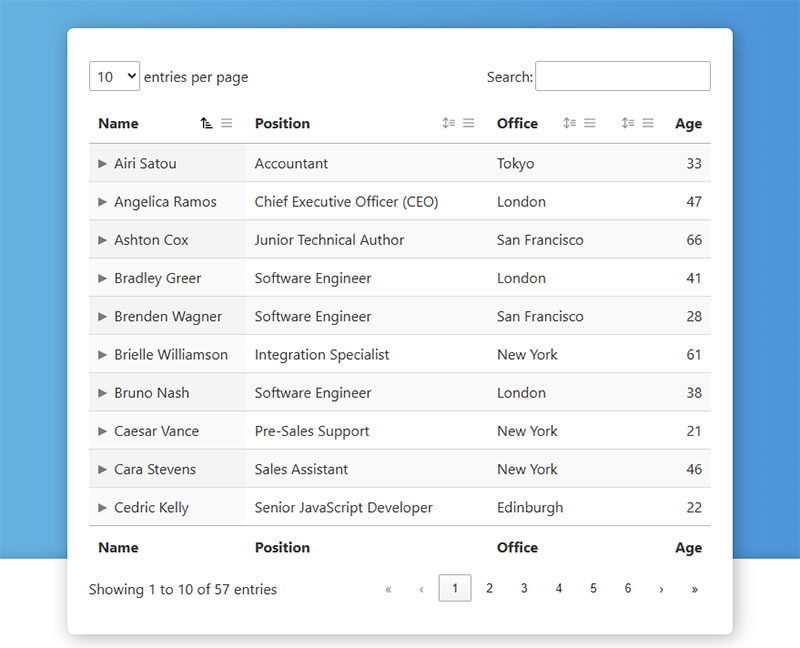
A jQuery HTML table enhancer. It wraps any standard table markup and adds pagination, multi-column sorting, AJAX loading, and on-the-fly filtering without a rewrite.
Key Features
- Multi-column sorting with automatic data type detection
- Variable-length table pagination and live text search
- Server-side processing via AJAX for large row counts
- Integrations for Bootstrap 3, 4, and 5, Bulma, and Semantic UI
- Extensions: Editor (inline editing), Responsive, FixedColumns, Buttons
Performance and Data Handling
Client-side processing works fine up to a few thousand rows.
For larger datasets, server-side processing offloads sorting and filtering to the backend, returning only the current page. That’s what makes DataTables a solid fit for enterprise-scale applications.
Customization and Integration
Works with plain HTML tables, JavaScript arrays, JSON, and AJAX feeds.
The extension ecosystem is the broadest of any plugin on this list. Bootstrap and Semantic UI theming requires no custom CSS.
Pricing and License
MIT license. Free for all projects.
The Editor extension (inline CRUD editing) is a paid add-on sold separately.
Best For
Projects that need the widest range of features and the most established documentation and community support.
Tabulator
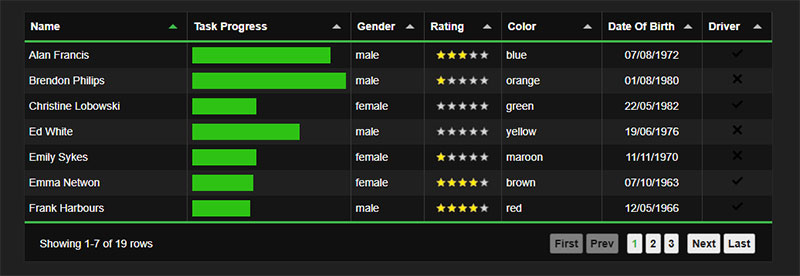
Started as a jQuery plugin. Now works as a standalone JavaScript library with no jQuery dependency required, which makes it useful across legacy and modern codebases.
Key Features
- Virtual DOM rendering draws only visible rows, not the full dataset
- Inline editing, row grouping, and column resizing built in
- Calculated columns and footer summation
- Accepts HTML tables, JS arrays, JSON, and AJAX feeds
- Data export to CSV, JSON, XLSX, and PDF
Performance and Data Handling
Tabulator processes 100,000+ rows without performance overhead.
The virtual DOM rebuilds only the visible window as users scroll. That’s different from how most jQuery data grid plugins handle large datasets, which render everything at once.
Customization and Integration
Bootstrap, Bulma, Materialize, and Semantic UI themes available.
Works in legacy jQuery environments and modern ES module setups. No required dependencies beyond the library itself.
Pricing and License
MIT license. Fully free and open source.
Best For
Data-heavy admin panels, reporting dashboards, and any project where row counts push past what client-side rendering handles comfortably.
Handsontable
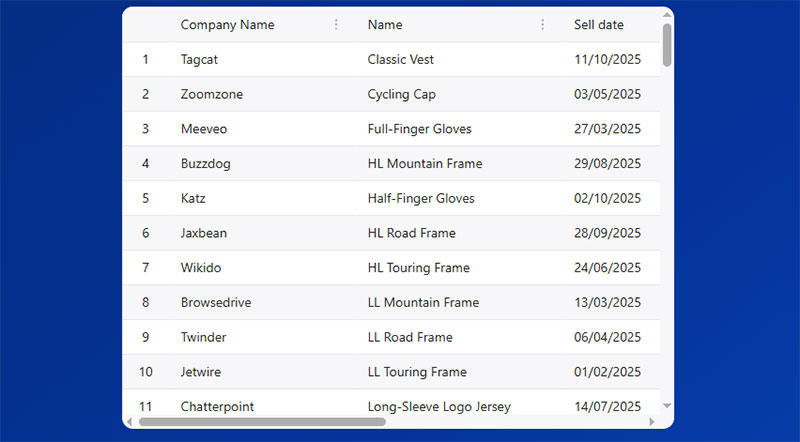
Not a display table. It’s a full browser-based spreadsheet.
Users click cells to edit, paste data from Excel, validate inputs on entry, and interact with rows and columns the way they would in a desktop app.
Key Features
- Cell editing with dropdown menus, date pickers, and custom renderers
- 400 spreadsheet formulas via HyperFormula integration
- Conditional formatting and data validation
- Copy-paste from Excel and Google Sheets
- Wrappers for React, Angular, and Vue
Performance and Data Handling
Handles large editable datasets through virtual rendering.
That said, Handsontable is optimized for interaction density, not raw row counts. It’s built for editing workflows, not read-only data display.
Customization and Integration
Supports Bootstrap and custom themes via a Theme API.
Works with JavaScript, TypeScript, React, Angular, and Vue. Keyboard shortcuts match either Excel or Google Sheets conventions, configurable per project.
Pricing and License
A Hobby license is available for free for personal, non-commercial projects only. It cannot be used in commercial settings or for commercially driven work.
Commercial license starts at $999 per developer (Handsontable pricing page, 2026).
Best For
Financial tools, data entry admin panels, and bulk editing workflows where users need to interact with data, not just read it.
SlickGrid
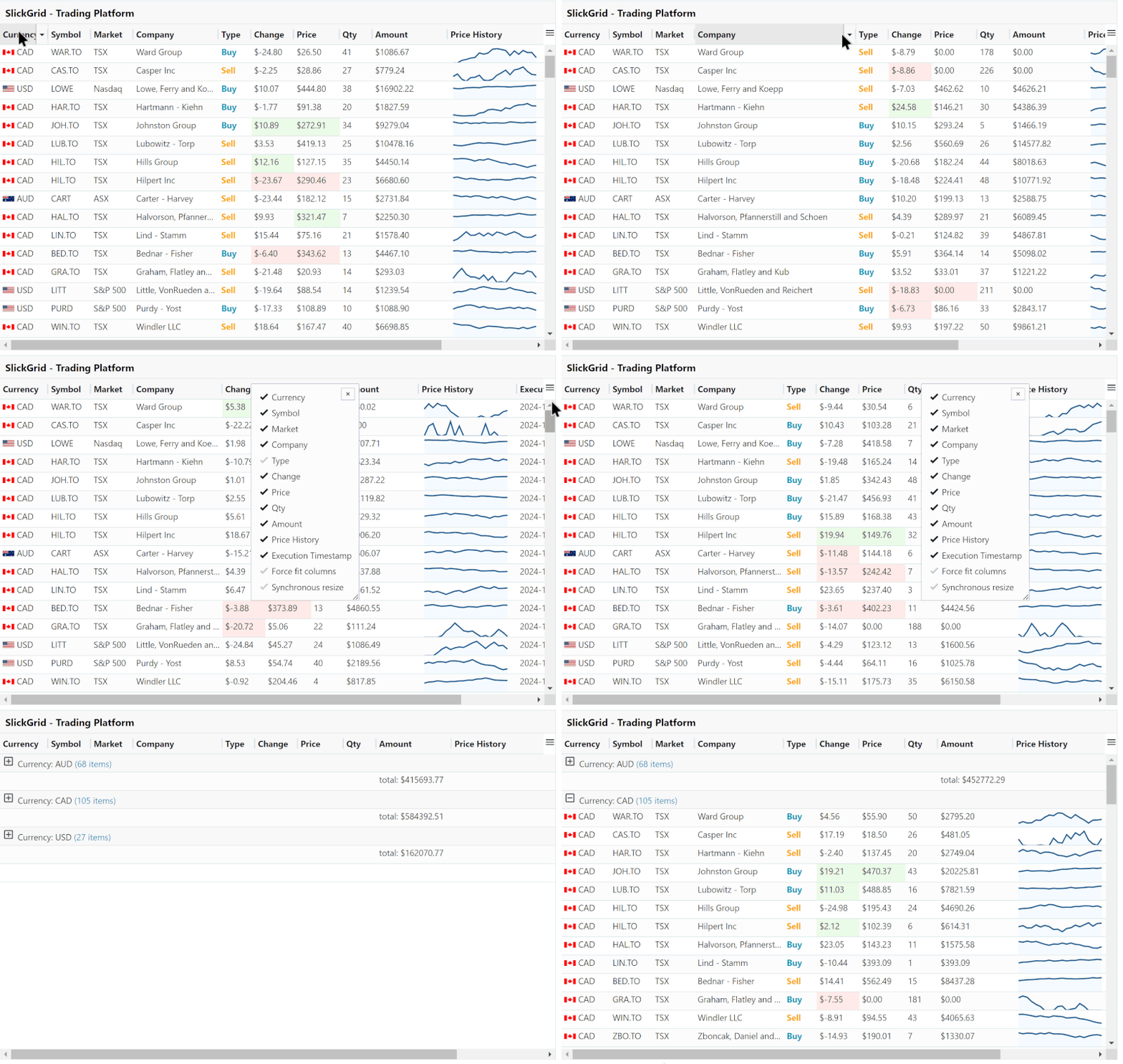
Built for one thing: rendering dense tables fast.
Key Features
- Handles hundreds of thousands of rows without lag
- Frozen columns and rows
- Multi-column sorting
- Cell-level and row-level editing
- Custom cell renderers and formatters
Performance and Data Handling
Row virtualization renders only the visible viewport.
SlickGrid was built for spreadsheet-style interaction at scale. Internal tools, financial dashboards, and data management screens with thousands of rows are where it actually shines.
Customization and Integration
Plain jQuery with no framework dependency.
Configuration is verbose. Not the right fit for content teams or non-developer workflows. Meant for developer-led builds.
Pricing and License
MIT license. Open source.
Best For
High-performance internal tools and dashboards where dataset size and scroll speed matter more than feature breadth.
Bootstrap Table
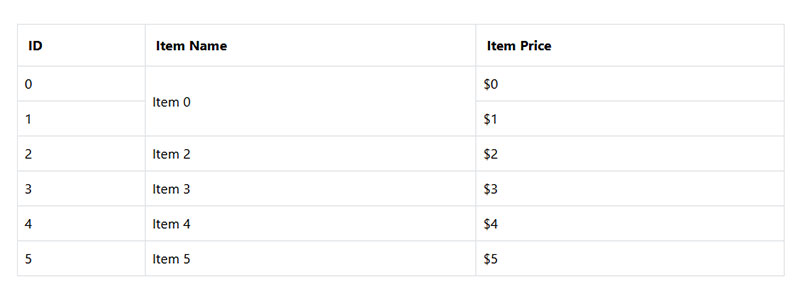
Built specifically for projects already running the Bootstrap framework.
It extends Bootstrap’s native table markup with interactive features and keeps the visual output consistent with an existing Bootstrap design system.
Key Features
- AJAX data loading and dynamic rendering
- Sorting, filtering, and table pagination
- Show/hide columns, fixed table headers, checkable rows
- Expandable and collapsible row groups
- Export to JSON, XML, CSV, TXT, SQL, and Excel
- Supports 45+ languages
Performance and Data Handling
Client-side and server-side data handling both supported.
Works well for medium-sized datasets. For very large row counts, server-side pagination keeps it responsive.
Customization and Integration
Compatible with Bootstrap 2, 3, 4, and 5, plus Bulma, Foundation, Materialize, and Semantic UI.
Five built-in themes. Extension system for additional functionality.
Pricing and License
MIT license. Fully free.
Best For
Bootstrap-based projects where visual consistency with existing UI components matters.
Looking to create data tables in WordPress?
wpDataTables can do that for you. There’s a good reason why it’s the #1 WordPress plugin for creating responsive tables and charts.
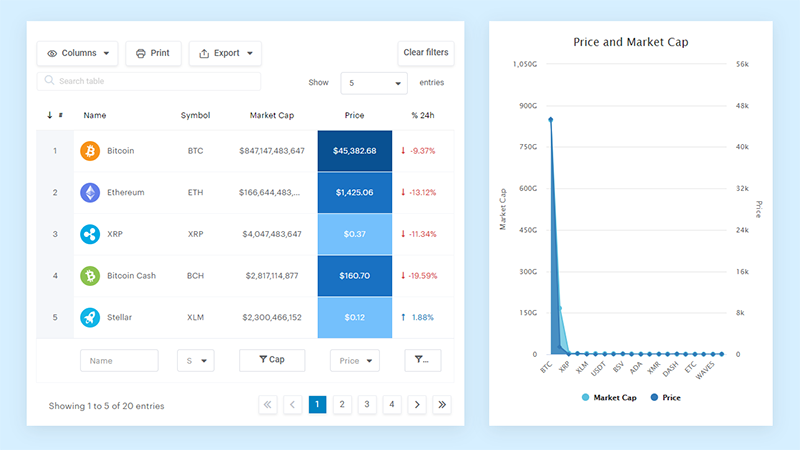
And it’s really easy to do something like this:
- You provide the table data
- Configure and customize it
- Publish it in a post or page
And it’s not just pretty, but also practical. You can make large tables with up to millions of rows, or you can use advanced filters and search, or you can go wild and make it editable.
“Yeah, but I just like Excel too much and there’s nothing like that on websites”. Yeah, there is. You can use conditional formatting like in Excel or Google Sheets.
Did I tell you you can create charts too with your data? And that’s only a small part. There are lots of other features for you.
FooTable
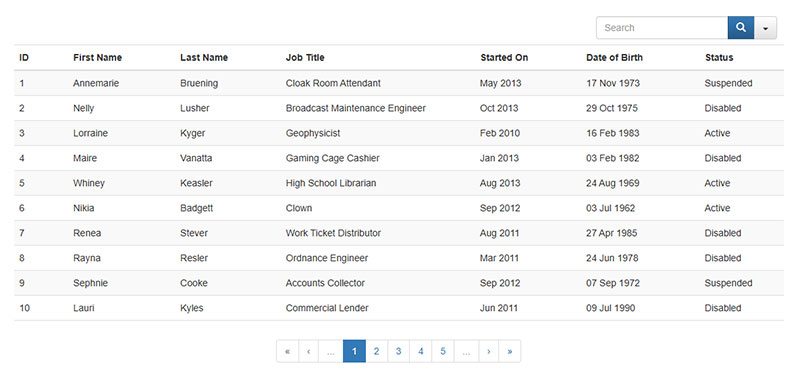
Takes a specific approach to mobile-friendly tables.
Rather than shrinking or horizontal-scrolling a wide table on small screens, it hides selected columns at defined breakpoints and lets users expand individual rows to reveal the hidden data.
Key Features
- Column hiding at defined breakpoints (not CSS scaling)
- Row expansion to reveal hidden column data
- Sorting and filtering built in
- Three ready-made themes plus custom CSS support
- Bootstrap compatible (also works without it)
Performance and Data Handling
Client-side only.
Works well for display tables with moderate row counts. Not suited for large datasets or server-side processing requirements.
Customization and Integration
Works with Bootstrap or standalone.
The breakpoint configuration controls which columns hide at which screen widths.
Pricing and License
MIT license. Open source.
Best For
Tables that need to work well on mobile devices where column-hiding beats horizontal scrolling.
jQuery Tablesorter
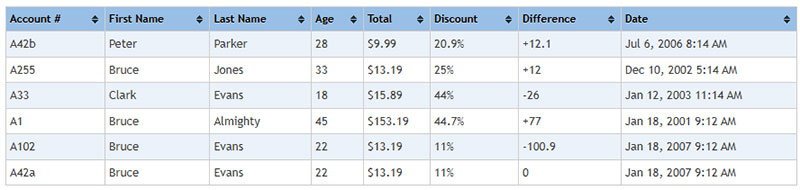
Does one thing. Does it well.
It turns any HTML table with THEAD and TBODY tags into a sortable table without a page refresh.
Key Features
- Parses text, numbers, currency, dates, IP addresses, and linked data
- Multi-column sorting (hold Shift to add columns)
- Secondary sort support
- Custom parsers for non-standard data types
- Tablesorter 2.0 fork adds filtering, pagination, sticky headers, and a widget system
Performance and Data Handling
Client-side only. No server-side processing support in the core plugin.
The 2.0 fork extends this, but for large datasets needing AJAX loading, DataTables or Tabulator are better options.
Customization and Integration
Works with jQuery 1.2.6+ and all major browsers.
Bootstrap V2-4 compatible. Widget system in the 2.0 fork adds column filters, resizing, and UI themes.
Pricing and License
MIT license. Fully free and open source.
Best For
Static or lightly dynamic HTML tables where column sorting is the main requirement and minimal setup is the priority.
Dynatable
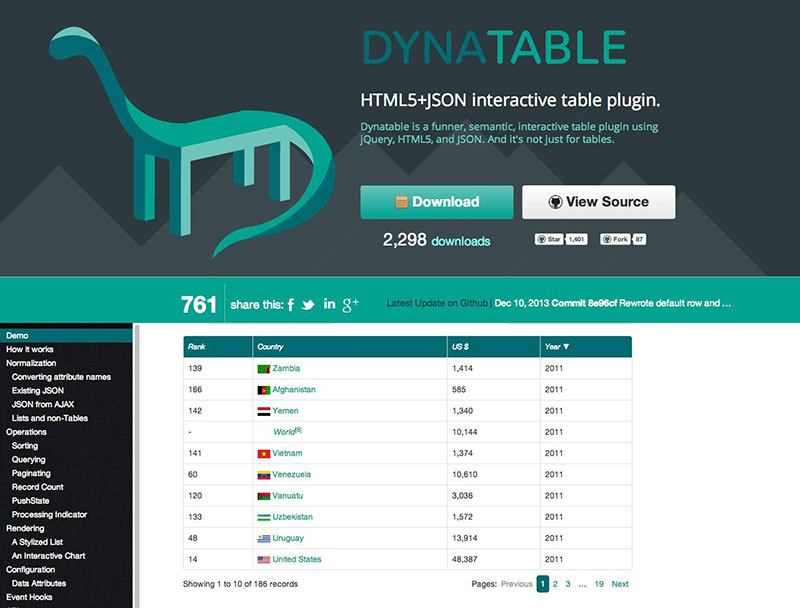
A semantic, HTML5+JSON interactive table plugin.
Where most jQuery table plugins wrap existing HTML markup, Dynatable uses a JSON data pipeline and HTML5 data attributes to drive filtering, sorting, and searching.
Key Features
- HTML5 and JSON-driven data handling
- Sorting, searching, and filtering out of the box
- Clean, extensible API
- Works with non-table HTML elements (lists, divs)
Performance and Data Handling
Client-side processing.
Suited for medium-sized datasets. The JSON data model makes it a cleaner fit for dynamic data than plugins that rely on parsing existing DOM table markup.
Customization and Integration
Plain jQuery, no framework dependency.
The API is intentionally minimal and extensible, which appeals to developers who want control over behavior rather than a pre-configured feature set.
Pricing and License
Open source. Free.
Best For
Developers who want semantic, JSON-driven table interaction with a clean API and no configuration overhead.
Herotable
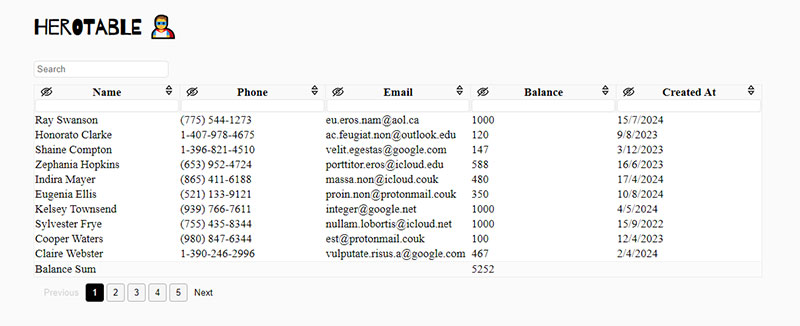
An all-in-one option that packs sorting, searching, filtering, column resizing, show/hide columns, footer summation, and pagination into a single plugin.
No extension management. No separate downloads for basic features.
Key Features
- Global search and per-column search
- Column resizing by drag
- Footer summation for numerical columns (totals, averages)
- Show/hide column visibility controls
- RTL mode support
- Callbacks for custom JavaScript triggers
Performance and Data Handling
Client-side only.
The footer summation feature is particularly practical for financial tables where column totals need to display automatically below data rows.
Customization and Integration
Minimal setup. Call $('table').herotable() on any HTML table.
No external framework dependency. Actively maintained with accessible documentation.
Pricing and License
Open source. Free.
Best For
Teams that want one plugin to cover multiple table behaviors without DataTables’ extension configuration overhead.
jsGrid
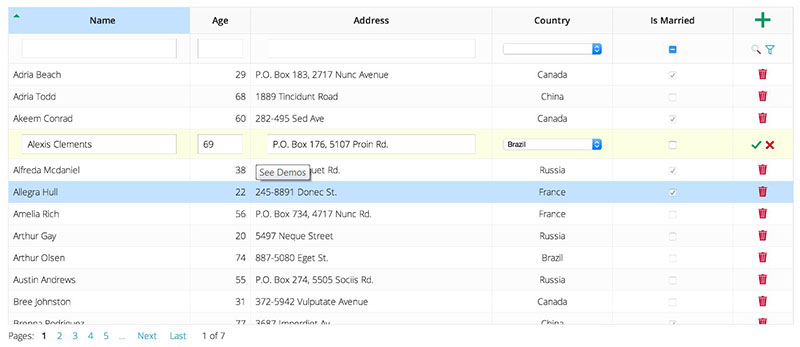
A lightweight CRUD data grid plugin for jQuery.
Unlike display-focused plugins, jsGrid is built for create, read, update, and delete workflows. Users add, edit, and delete rows directly in the table.
Key Features
- Inline row insertion, editing, and deletion
- Sorting and filtering
- Client-side and server-side data support
- Custom field types
- Validation built in
Performance and Data Handling
Works well for moderate datasets.
Server-side support means it can pull from a REST API or database endpoint for JavaScript data table applications that need live data.
Customization and Integration
Works with Bootstrap and plain HTML.
Custom field types allow non-standard cells like dropdowns, checkboxes, and date pickers.
Pricing and License
MIT license. Fully free.
Best For
Admin panels and internal tools where users need to manage records directly in a table interface.
What Makes a jQuery Table Plugin Worth Using
Not every plugin that adds sorting to an HTML table deserves to be in a production project.
The difference between a plugin that lasts and one that breaks three months in comes down to a handful of attributes: feature coverage, performance ceiling, integration flexibility, license terms, and whether the maintainer is still active.
| Attribute | What to Check |
|---|---|
| Core features | Sorting, filtering, pagination, AJAX support |
| Performance ceiling | Client-side row limit before slowdown |
| Integration | Bootstrap, plain HTML, or framework-agnostic |
| License | MIT vs. commercial, especially for SaaS products |
| Maintenance | Last GitHub commit, open issue response rate |
W3Techs data shows jQuery runs on 77.8% of the top 10 million websites as of 2025. That’s a lot of legacy codebases still needing reliable table plugins.
Feature completeness matters more than raw feature count. A plugin with sorting, filtering, and pagination covers 90% of real-world requirements. Beyond that, you’re paying for complexity you may not need.
License type trips up more developers than expected. Handsontable’s commercial tier starts at $790 per developer. For open-source or side projects, that’s a dealbreaker. For an enterprise finance dashboard, it’s reasonable.
Documentation quality and an active GitHub repository are non-negotiable signals. A plugin with 3,000 GitHub stars but no commits in two years is a liability.
How jQuery Table Plugins Handle Large Datasets
Raw row count is where most jQuery table plugins reveal their limits.
Client-side plugins render all rows into the DOM at load time. That works for 500 rows. It starts lagging around 5,000. Above 10,000, the browser chokes on most standard implementations.
Client-Side vs. Server-Side Processing in jQuery Tables
Client-side processing:
- All data loaded into the browser at once
- Sorting and filtering happen locally in JavaScript
- Fast user interaction after initial load
- Practical ceiling: roughly 5,000-10,000 rows depending on complexity
Server-side processing:
- Each table draw triggers a new AJAX request
- Sorting, filtering, and pagination handled by the database
- Browser receives only the current page of results
- DataTables documentation confirms this supports millions of rows in production deployments
Server-side processing is the right call when row counts exceed what the client can handle without lag, when data changes frequently, or when users need real-time search across a full dataset.
The DataTables forum has documented deployments with 20 million+ records using server-side processing with MariaDB. That’s a different category of use case from a 500-row product table.
Which Plugins Use Virtual DOM Rendering
Tabulator’s virtual DOM rendering is the most practical client-side solution for large datasets.
According to Tabulator’s official documentation, virtual DOM mode processes 100,000+ rows without performance overhead by rendering only the rows visible in the current viewport plus a small buffer above and below.
As the user scrolls, rows are created and destroyed outside the visible area. The browser never holds more than a screen’s worth of DOM nodes at once.
- Tabulator: Virtual DOM enabled by default when height is set; handles 100k+ rows
- SlickGrid: Row virtualization built in; designed for spreadsheet-scale performance
- DataTables: No native virtual rendering; relies on server-side processing for very large sets
- FooTable / Tablesorter / Herotable: Client-side only; not suitable above ~5,000 rows
For admin dashboards or reporting tools pulling from large databases, Tabulator or SlickGrid handle the rendering side. The database query performance is a separate concern.
jQuery Table Plugins for Responsive and Mobile Layouts
Mobile devices now account for 60.5% of global web traffic as of mid-2025, according to StatCounter data reported by Visual Capitalist.
That number makes responsive table behavior a functional requirement, not a nice-to-have. Wide tables with 8-10 columns simply do not fit on a 390px screen.
Column Hiding vs. Horizontal Scroll: Which Approach Works on Mobile
Three approaches exist. They produce very different user experiences.
Column hiding (FooTable approach):
See the Pen
Column Hiding on Mobile with FooTable by Bogdan Sandu (@bogdansandu)
on CodePen.
Columns marked as low-priority collapse at defined breakpoints. Users expand individual rows to reveal hidden data. No horizontal scroll. No squished columns.
This works well when some columns are clearly secondary (status flags, internal IDs, notes fields).
Horizontal scroll:
The table stays full-width and the container scrolls. Simple to implement. Frustrating on touch devices where horizontal swipe competes with page navigation.
CSS scaling / column compression:
Columns shrink to fit. Text truncates. Readable at 768px. Unreadable at 390px.
FooTable’s column-hiding approach works better than CSS scaling for wide tables on small screens. The column-hiding pattern keeps all data accessible without forcing users to scroll horizontally across a cramped grid.
Bootstrap Table’s card view toggle is a solid alternative. It switches from a row-column layout to a stacked card format on small screens, which works well for data where each row represents a distinct record (orders, contacts, products).
StatCounter reports B2B SaaS sits at 34.7% mobile traffic (Contentsquare, 2024), which is lower than consumer sectors. But even at that rate, one in three users is on a phone. A table that breaks on mobile breaks for a third of your users.
jQuery Table Plugins With Inline Editing and CRUD Support
Display-only tables cover a lot of use cases. Admin panels and data management tools need more.
Handsontable is the clearest example of a jQuery-compatible data grid built for edit-heavy workflows. The plugin brings spreadsheet-style interaction into the browser: click a cell to edit, paste from Excel, validate inputs on entry, navigate with keyboard shortcuts that match either Google Sheets or Excel conventions.
Handsontable’s cell type support:
- Text, numeric, date, time, checkbox
- Dropdown menus and autocomplete editors
- Custom cell renderers for any data type
- 400 spreadsheet formulas via HyperFormula integration
Handsontable is free for non-commercial use. The commercial license starts at $790 per developer.
For projects that need CRUD without the spreadsheet layer, jsGrid provides a cleaner fit. Row insertion, editing, and deletion happen directly in the table. Validation runs on the client. Server-side endpoints handle persistence. The setup is lighter than Handsontable and the licensing is MIT.
DataTables’ Editor extension adds inline editing to DataTables’ existing feature set, but it is a paid add-on. For teams already running DataTables in production, it’s a natural upgrade. For new projects, jsGrid or Tabulator’s editable cells cover the same ground without additional cost.
Tabulator handles editable cells natively, including calculated columns that update automatically when dependent cells change. That makes it the strongest free option for read-write data grids that also need to display aggregated values.
How to Choose the Right jQuery Table Plugin for Your Project
Wrong plugin selection is expensive. You end up either stripping out features you never needed or bolting on extensions to cover gaps.
The table below maps common project types to the plugin that fits them best.
| Project Type | Best Fit | Why |
|---|---|---|
| Enterprise data interface | DataTables | Broadest extension ecosystem, enterprise support |
| 50k+ row reporting tool | Tabulator | Virtual DOM, MIT license |
| Excel-style data entry | Handsontable | Spreadsheet UX, formula support |
| Bootstrap-native project | Bootstrap Table | Native Bootstrap styling, no CSS conflicts |
| Mobile-first table | FooTable | Column hiding beats horizontal scroll |
| Static table, column sort only | jQuery Tablesorter | Zero setup, MIT license |
| All-in-one, no extension setup | Herotable | Single plugin covers sorting, filtering, pagination, sums |
| Admin CRUD panel | jsGrid | Row insert, edit, delete, validation built in |
jQuery Table Plugins for WordPress vs. Standalone Projects
WordPress powers 43.4% of all websites as of 2025, according to W3Techs. That’s a massive portion of the web running a CMS with its own plugin ecosystem.
jQuery table plugins work in WordPress. Drop the scripts into a child theme or load them via a plugin. But the developer experience is rougher than using a native WordPress table plugin because you’re managing script loading, conflicts with other jQuery instances, and theme compatibility manually.
For WordPress-specific use cases, dedicated WordPress table plugins built around the WP admin and editor workflow save significant setup time. We obviously recommend wpDataTables for this.
For standalone HTML projects, legacy jQuery applications, or custom web apps outside WordPress, the plugins on this list are the right tools. The licensing, documentation, and feature depth all scale to what these environments require.
Key decision points:
- Building inside WordPress with non-technical editors: use a native WP table plugin
- Building inside WordPress with developer control: jQuery plugins work, but add friction
- Standalone web app or legacy jQuery codebase: jQuery table plugins are the correct choice
How jQuery Table Plugins Integrate With External Data Sources
Static HTML tables work for fixed content. Most production tables pull data from a backend.
AJAX data loading is supported across DataTables, Tabulator, Bootstrap Table, and jsGrid. The implementation differs between plugins, but the pattern is consistent: define an endpoint, configure the request format, and the plugin handles the rendering.
Setting Up AJAX Data Loading in DataTables and Tabulator
DataTables AJAX setup is straightforward. Set the ajax option to a URL or a configuration object, and DataTables sends a GET request on initialization and on each pagination, sort, or filter action.
For server-side processing, set serverSide: true. DataTables then sends query parameters (page number, sort column, search term) with each request, and the server returns only the relevant page of data.
DataTables AJAX configuration options:
ajax: 'api/data.json'for simple endpointajax: { url, type, data }for custom request headers or POSTserverSide: truefor large dataset server processingdeferLoadingto control when the initial request fires
Tabulator handles JSON to HTML table conversion natively.
Pass a URL string to the ajaxURL property and Tabulator fetches and renders the data. Remote sorting and filtering work through request parameters that the server parses and responds to.
Tabulator remote data options:
ajaxURL: endpoint for JSON dataajaxParams: static parameters added to every requestajaxSorting: trueandajaxFiltering: truefor server-side operationsprogressiveLoad: "scroll"for infinite scroll pagination
Both plugins accept JavaScript sorting tables and filter a table with JavaScript on the client side when AJAX data is loaded all at once, or delegate those operations to the server when the dataset is too large for client handling.
Export options vary by plugin. Tabulator exports to CSV, JSON, XLSX, and PDF natively. DataTables requires the Buttons extension for export functionality. Bootstrap Table includes JSON, XML, CSV, TXT, SQL, and Excel export out of the box without additional extensions.
For REST API integration, both DataTables and Tabulator support custom AJAX request configuration, which covers authentication headers, custom response parsing, and error handling for production API endpoints.
FAQ on jQuery Table Plugins
What is a jQuery table plugin?
A jQuery table plugin is a JavaScript library that adds interactive features to a standard HTML table. Common additions include column sorting, live search, client-side pagination, AJAX data loading, and responsive layouts. None of these behaviors exist in plain HTML without JavaScript.
What is the best jQuery table plugin overall?
DataTables is the most widely used. It has the broadest extension ecosystem, solid documentation, and supports both client-side and server-side processing. For large datasets needing virtual DOM rendering, Tabulator is the stronger technical choice.
Which jQuery table plugin works best for large datasets?
Tabulator. Its virtual DOM rendering processes 100,000+ rows without performance overhead by rendering only visible rows. DataTables handles large sets through server-side processing, offloading sorting and filtering to a database engine.
Are jQuery table plugins still relevant in 2025?
Yes. jQuery runs on 77.8% of the top 10 million websites (W3Techs, 2025). Legacy codebases, WordPress environments, and enterprise platforms still depend on jQuery daily. The plugins are actively maintained and solve real production problems.
Which plugin is best for responsive and mobile layouts?
FooTable. It hides lower-priority columns at defined breakpoints instead of scaling or horizontal scrolling. Users expand rows to see hidden data. Bootstrap Table’s card view toggle is a solid alternative for Bootstrap-based projects.
Is there a free jQuery data grid plugin with inline editing?
jsGrid offers free MIT-licensed CRUD functionality including row insert, edit, and delete with validation. Tabulator also supports editable cells natively at no cost. Handsontable provides Excel-style editing but requires a commercial license for business use.
How do jQuery table plugins handle AJAX data loading?
Most accept a URL endpoint and fetch JSON data on initialization. DataTables and Tabulator both support remote sorting, filtering, and pagination by sending query parameters to the server and rendering only the returned page of results.
What is the difference between client-side and server-side processing?
Client-side loads all data into the browser at once. Fast interaction, but slow above 10,000 rows. Server-side processing sends each sort, filter, or page request to the backend, keeping the browser fast regardless of total row count.
Which jQuery table plugin works best with Bootstrap?
Bootstrap Table. It extends Bootstrap’s native table markup using data attributes, requires minimal JavaScript configuration, and stays visually consistent with existing Bootstrap 3, 4, or 5 design systems. It supports AJAX loading, sorting, and export out of the box.
Can jQuery table plugins export data to CSV or Excel?
Yes. Tabulator exports to CSV, JSON, XLSX, and PDF natively. Bootstrap Table includes CSV, XML, SQL, and Excel export without extra extensions. DataTables requires the Buttons extension for export functionality, which is free and straightforward to configure.
Conclusion
Choosing from the best jQuery table plugins comes down to one question: what does your data actually need to do?
DataTables covers the widest range of use cases with its extension ecosystem. Tabulator handles virtual DOM rendering for large row counts. Handsontable fits edit-heavy workflows. FooTable solves the mobile layout problem cleanly.
No single plugin wins every scenario.
The right pick depends on your dataset size, whether you need server-side processing, your CSS framework, and your license requirements.
Most projects need sorting, filtering, and responsive table behavior, and any MIT-licensed plugin on this list delivers that without cost or complexity.
Start with the feature your project requires most. Match the plugin to that requirement. Everything else follows.