
The default WordPress table block gives you rows and columns and stops there. No sorting, no filtering, no spreadsheet import, and it falls apart past a few columns on a phone.
So you install a plugin. The decision that actually matters, and the one people make too late, is whether your data changes.
A static builder and a live-synced data platform are different tools. Pick the wrong side and you either retype rows by hand forever or pay for a query engine you never open. That’s the split running underneath every comparison table plugin below.
We tested the leading options against the same jobs: pulling from a data source, styling without CSS, and rendering clean on mobile.
Table of Contents
The Best Comparison Table Plugins for WordPress
Most capable first, descending toward the lighter single-purpose builders.
Every pick here is a genuine WordPress table plugin, tested on the same four jobs: build without HTML, pull from a data source, render clean, embed back into a post.
| Plugin | Best For | Entry Price |
|---|---|---|
| wpDataTables | Large datasets + charts | Free Lite ~$59/yr |
| TablePress | Lightweight static tables | Free $89/yr Pro |
| Ninja Tables | Styling without CSS | Free ~$79/yr |
| WP Table Builder | Affiliate + pricing tables | Free Pro add-on |
| League Table | Sports and rankings | Free $24 one-time |
wpDataTables – Best for data-heavy sites that need live sources and charts
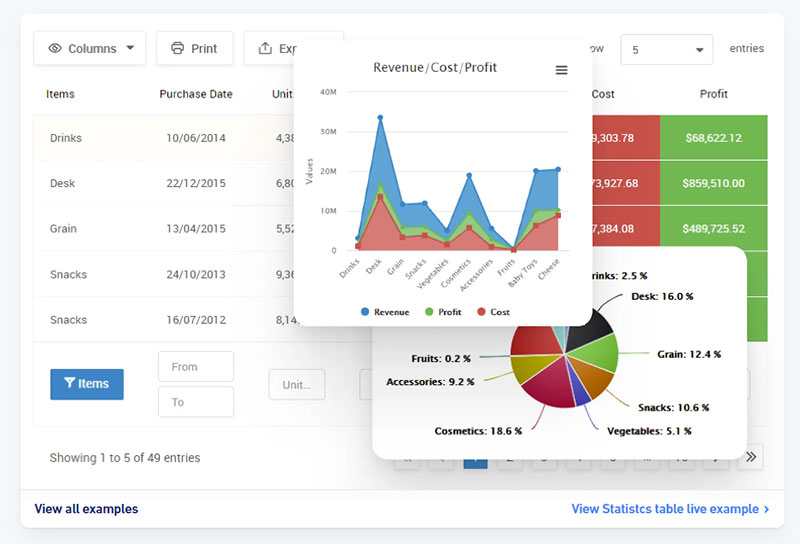
wpDataTables is the strongest pick when your data lives outside WordPress and the table has to sync and scale. Responsive, filterable tables and charts built straight from Excel, CSV, Google Sheets, MySQL, or JSON.
Best for site owners with thousands of rows pulled from a real database or spreadsheet. The standout is live MySQL query tables with a SQL builder, plus charts sitting right next to the data.
What you get:
- Data from Excel, CSV, JSON, XML, Google Sheets, MySQL
- Highcharts, Chart.js, and Google Charts engines for interactive charts
- Conditional formatting, sortable columns, pagination
- Front-end editing so non-admins update rows from the live page
- Native WooCommerce product table generation
Pricing: Free Lite on WordPress.org, capped at 150 rows with database sources excluded. Four annual tiers ladder up from roughly $59 (Starter, one domain) through Standard and Pro to the Developer tier, which independent listings put closer to $398 per year for unlimited domains. Lifetime licenses are available on higher tiers, with a 15-day money-back guarantee. Pricing moves with promotions, so confirm the current grid on wpdatatables.com.
Where it wins:
- Widest range of data sources on this list
- Charts and tables share one interface
- Mobile responsiveness configurable per table
Where it falls short:
- The live-source pipeline is premium. Lite covers basic tables, while database and spreadsheet connections come with a paid license
- Very large tables want server-side processing switched on, otherwise the back end has more to chew through than it needs to
We ran a sandbox test on WordPress 7.0, where the SQL query builder connected to a MySQL source in under a minute and rendered a filtered 4,000-row table with a linked bar chart. Support tickets on the vendor site show quick, hands-on replies about custom setups.
The periodic data-sync setting is the underrated part. It quietly refreshes tables from the source on a schedule, so a published Google Sheet or database stays current without manual re-import. Most roundups skip it entirely.
TablePress – Best for lightweight static tables with zero bloat
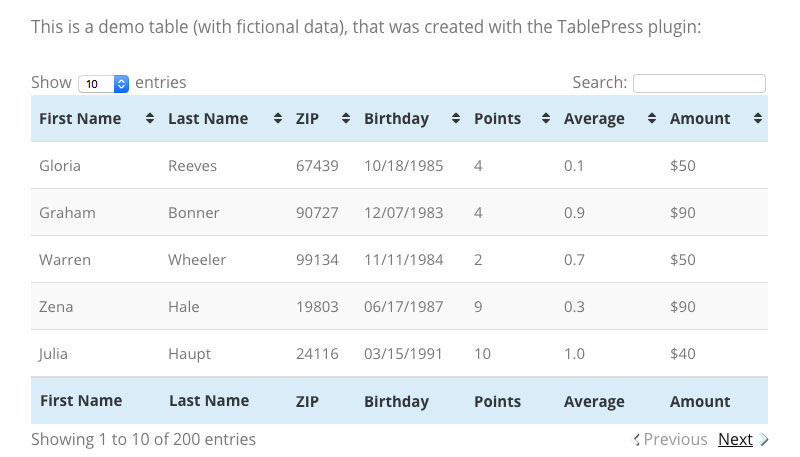
TablePress has the lightest footprint here: minimal CSS and JavaScript, no external dependencies. It’s the most-installed table plugin on WordPress, built around a spreadsheet-style editor.
Best for bloggers and small sites that need tidy tables without touching performance budgets.
What you get:
- Spreadsheet-like editor in the dashboard
- Import and export via Excel, CSV, HTML, JSON
- Merge, split, and duplicate cells
- Shortcode or block embedding
- 700,000+ active installs, a 5.0 average rating, and a large extension library
Pricing: Core is free. Pro runs $89/year and Max $189/year, with lifetime licenses at $389 and $789 respectively. Pricing is listed in euros on the vendor site in some regions.
Where it wins:
- Rock-solid stability
- Intuitive for anyone who has used Google Sheets
- Deep extension ecosystem
Where it falls short:
- Free version lacks responsive column-priority layouts and relies on horizontal scroll on mobile
- No pre-built templates
- Server-side processing and automatic periodic imports are Max-tier only
Install-and-go with no configuration screen. In testing, we watched a 12-column table scroll sideways on a phone in the free tier until the Pro responsive mode was enabled. If it turns out not to fit, the vendor covers other options worth weighing.
One thing to know before you commit: because tables live in the database, an accidental delete is unrecoverable without a backup. Uninstalling the plugin permanently deletes your tables, and cancelling a premium subscription reverts them to free-version behaviour. Export before you do either.
Ninja Tables – Best for styling rich tables without writing CSS

Ninja Tables has the easiest styling on this list. Drag-and-drop, clean mobile output, and no stylesheets to touch.
Best for design-conscious owners who want polished tables fast, plus WooCommerce shops. The build modal offers Fluent Forms, Google Sheets, CSV, WP Posts, or custom SQL as sources, and the stackable responsive layouts handle small screens properly.
What you get:
- Drag-and-drop editor (Pro)
- Live Google Sheets and CSV connections
- WooCommerce integration and media attachments
- Value transformation and data calculations
- Deep tie-ins with Fluent Forms and FluentBooking
Pricing: Free core plugin with 80,000+ active installs and a 4.6 rating. Pro starts around $79 per domain per year, with lifetime licenses available. Confirm current tiers on ninjatables.com.
Where it wins:
- Ships pre-built templates and colour schemes
- Fast rendering even on very large tables
Where it falls short:
- Advanced colour pickers and drag-and-drop sit in Pro
- Chart output is thinner than wpDataTables, and charting runs through the separate Ninja Charts plugin
One reviewer loaded a 60,000-row table that rendered fast where heavier plugins stalled on the back end. In our own testing, the build modal made source selection the clearest step of any tool here.
The Fluent ecosystem lock-in is underrated, though. If you already run Fluent Forms, live submission tables appear with almost no setup. If you don’t, that value evaporates.
WP Table Builder – Best for affiliate reviews and pricing comparisons
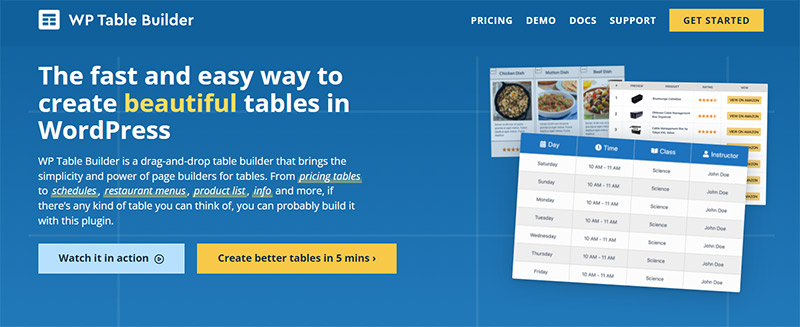
WP Table Builder designs cells element by element, so star ratings and CTA buttons drop in visually. That’s faster than a spreadsheet for review and pricing table layouts, which is exactly who it’s aimed at.
Best for affiliate and review sites building pros-and-cons or side-by-side comparison tables.
What you get:
- Drag-and-drop cell elements
- Works as its own Gutenberg block
- Merge and split cells, add or remove rows and columns
- Pro templates for pricing boxes and comparisons
Pricing: Free on WordPress.org, rated 4.8. Paid tiers start around $39/year for a single site, with an unlimited-site plan and a lifetime option. Check wptablebuilder.com for current rates.
Where it wins:
- Predictable responsive behavior
- Cleanest visual builder for review content
- Generous free tier
Where it falls short:
- No database connections, no Google Sheets sync, no charts. It’s a builder, not a data platform
- Compatibility header lists testing up to WordPress 6.9.4, so it hasn’t yet been declared compatible with WordPress 7.0, which shipped in May 2026
Testing the New Table screen, we found row and column sliders capped at 10 in the free tier, plenty for a comparison post but limiting for anything data-driven.
For affiliate work the spreadsheet model is simply the wrong tool. That’s the trade-off most “best table plugin” pages gloss over.
League Table – Best for sports standings and ranked lists

League Table started as a sports-standings tool and kept that granular per-cell control tuned for rankings. It has since grown into a general builder with a spreadsheet editor, on a near-zero budget.
Best for sports sites, leaderboards, and any ranked list where order is the point.
What you get:
- Sortable columns and responsive layouts
- Import from Excel, OpenOffice, LibreOffice, Google Sheets (copy-paste)
- Shortcode embedding
- Multisite support in Pro
Pricing: Free version on WordPress.org. Pro is a one-time CodeCanyon purchase around $24, the cheapest premium tier on this list by a wide margin.
Where it wins:
- Cheapest paid upgrade here
- Capable free feature set
- Purpose-built for standings
Where it falls short:
- No native Gutenberg block, a real gap in 2026
- Responsive relies on horizontal scroll
- No live sync
Copy-paste import from a Google Sheet worked for a standings table, but our edits to the source didn’t flow back, confirming there’s no live connection.
That one-time price is the hook. The missing block editor means embedding feels dated next to modern responsive builders, so it’s worth it only if standings are your core use case.
How to choose the right one
Data source is the deciding factor. If your numbers live in a database or spreadsheet and have to stay current, the choice narrows fast.
| Your Need | Pick |
|---|---|
| Live MySQL / Sheets + charts | wpDataTables |
| Fast static tables, low weight | TablePress |
| Styling without CSS | Ninja Tables |
| Affiliate comparisons | WP Table Builder |
| Ranked standings on a budget | League Table |
Past a handful of static rows, the plugins with real source integration pull ahead. The rest are excellent at their one job and lighter for it.
What separates a strong comparison table plugin from a basic one
The default block gives you rows and columns and nothing else. No sorting, no filtering, no spreadsheet import, and mobile output that breaks past a few columns.
A real plugin has to build without HTML, pull from a data source, render cleanly on any screen, and embed without wrecking your theme. All at once.
W3Techs data shows WordPress powers roughly 41% to 42% of all websites and holds about 60% of the CMS market, easing back from a peak above 43%, so the plugin ecosystem around it is deep.
That depth cuts both ways. With around 60,000 plugins in the directory, the gap between a capable builder and a throwaway one is wide.
The features that actually matter
Any decent tool should clear this floor:
- Sortable columns and a working search box
- Conditional formatting to highlight rows or cells
- Pagination for anything past 25 rows
- Merge and split cells for headers
Miss two of those and you’re looking at a toy, not a tool.
Builder versus data platform
The real split is between a visual cell builder and a data platform. One designs cells by hand. The other connects to a source and scales.
WP Table Builder sits firmly on the first side, doing element-by-element design that’s great for a fixed comparison post. wpDataTables sits on the second, running a data pipeline that handles thousands of rows from a database.
Pick the wrong side and you either rebuild rows by hand forever or pay for a query engine you never touch.
Why back-end speed counts
Cost of retrieval isn’t just a front-end concern. Some plugins choke loading large tables in the editor.
One documented user case had wpDataTables and TablePress stalling on a table of thousands of rows in the admin, while Ninja Tables loaded 60,000 rows without a hang.
Which data sources these plugins can connect to
Where your data lives decides the plugin more than any styling feature. A static table and a live-synced table are different animals.
Static means you paste or type once. Live means the table refreshes when the source changes, no manual re-import.
| Source | Live Sync | Best Supported By |
|---|---|---|
| MySQL / SQL query | Yes | wpDataTables |
| Google Sheets | Yes | wpDataTables·Ninja Tables |
| Excel / CSV | Import | Most plugins |
| JSON / XML | Import | wpDataTables |
Live connections versus copy-paste
The sync gap is the dividing line. Ninja Tables and wpDataTables hold a live connection to a published sheet. League Table only takes a copy-paste.
Edit the source sheet and a synced table updates on its own. A pasted table sits frozen until you redo the import.
For a dataset that changes weekly, that difference is the whole ballgame.
Pulling straight from a database
wpDataTables ships a query builder that connects to MySQL and turns a query into a table, which is the SQL route done properly.
You can also turn a live Google Sheet into a chart-ready table without exporting anything.
This is where a JavaScript-driven data table earns its keep, filtering and sorting thousands of rows client-side.
Product data as a source
WooCommerce doubles as a data source, and roughly one-third of all online shops run on it.
That makes native product comparison tables a common ask for store owners building catalogs and spec sheets.
What free versions include and what the paid tiers unlock
Free tiers are generous on entry and stingy on the features that scale. The paywall almost always sits in the same place: responsive layouts, database queries, and front-end editing.
TablePress alone runs on over 700,000 active installs, proof that a free table plugin covers most simple needs.
| Plugin | Free Tier | Paid Entry |
|---|---|---|
| wpDataTables | Lite, 150-row cap | ~$59/yr |
| TablePress | Full core | $89/yr Pro |
| Ninja Tables | Core + templates | ~$79/yr |
| League Table | Free version | ~$24 one-time |
Where the paywall sits
The gated features cluster predictably across the field:
- Responsive modes: TablePress hides column-priority layouts behind Pro
- Database queries: wpDataTables Lite blocks SQL and dynamic sources
- Front-end editing: premium-only in wpDataTables
- Drag-and-drop styling: Ninja Tables Pro
- Server-side processing: TablePress Max only
One-time versus annual
League Table breaks the subscription pattern with a single CodeCanyon purchase around $24. TablePress lifetime licenses run $389 for Pro and $789 for Max.
Annual pricing makes sense if you want ongoing updates and support. Lifetime pays off past roughly four years on the same site.
Do the math on how long the site will actually live before you commit.
How comparison tables stay readable on mobile
Mobile isn’t a corner case anymore. StatCounter has recorded mobile at roughly 62% to 64% of global web traffic through 2025, up from around 60% in early 2024.
A table that scrolls sideways off the screen is a table most of your visitors won’t read.
Scroll versus stack
Two responsive strategies dominate, and they aren’t equal.
Horizontal scroll keeps the layout intact but hides columns off-screen. Column-priority stacking reflows the table so it fits the viewport instead.
TablePress free and League Table lean on horizontal scroll. Ninja Tables and wpDataTables offer configurable stacking out of the box.
Per-cell control and page speed
WP Table Builder Pro adds per-cell responsive controls, since it builds element by element.
Every table plugin loads extra CSS and JavaScript, which touches Core Web Vitals. Google’s widely cited research found 53% of mobile visits are abandoned when a page takes over three seconds to load. That figure comes from a 2016 study, but the underlying principle has held up.
Learn how to make a table adapt to small screens before you publish, not after the bounce rate climbs.
Where comparison tables get used most
Same tools, different question. The table further up sorts by what your data looks like; this one sorts by what the page is for.
Comparison tables show up in a handful of predictable jobs, and each one favours a different plugin.
NASA and Microsoft both run WordPress properties, which shows the platform scales from a solo blog to enterprise catalogs.
| Use Case | What It Needs | Strong Pick |
|---|---|---|
| Affiliate reviews | Stars, buttons, images in cells | WP Table Builder |
| Pricing plans | Toggles, badges, feature rows | Ninja Tables |
| Product catalogs | WooCommerce data, filters | wpDataTables |
| Sports standings | Ranked, sortable rows | League Table |
Affiliate and pricing layouts
Review content lives on cell elements: rating stars, CTA buttons, product thumbnails.
WP Table Builder’s visual editor drops those in faster than any spreadsheet model, which is why affiliate sites lean on it.
Pricing grids want a different shape. Toggles, ribbons, and side-by-side plan columns, the kind of layout you can study in real pricing table examples.
Catalogs, standings, and dashboards
Data-heavy jobs pull toward source-connected plugins:
- Catalogs: WooCommerce product tables with live filters
- Standings: ranked, sortable league layouts
- Dashboards: database-fed tables paired with charts
All three break a hand-built table quickly, which is the practical reason source integration keeps winning at volume.
FAQ About Comparison Table Plugins
What is the best comparison table plugin for WordPress?
wpDataTables ranks first for most sites. It builds responsive, sortable tables from Excel, CSV, Google Sheets, or MySQL, and pairs them with charts. TablePress and Ninja Tables are strong picks for lighter, simpler needs.
Is wpDataTables free to use?
Yes, a free Lite version sits on WordPress.org. It caps tables at 150 rows and blocks database queries. Premium tiers start around $59 per year and unlock MySQL, conditional formatting, and front-end editing.
Can I build a comparison table without a plugin?
You can, using raw HTML and CSS, but it gets painful fast. There is no sorting, filtering, or mobile handling. Learning to create a table without a plugin works only for tiny, static grids.
Do table plugins slow down a WordPress site?
A poorly built one can. Each plugin loads extra CSS and JavaScript that touches Core Web Vitals. Lightweight options like TablePress add minimal weight, while heavier data platforms cost more on pages with thousands of rows.
Which plugin handles large datasets best?
wpDataTables and Ninja Tables lead here. Both render thousands of rows without stalling, and wpDataTables pulls live from a database through its SQL query builder. One documented case loaded 60,000 rows smoothly in Ninja Tables.
Are comparison tables mobile responsive?
The good ones are. Ninja Tables and wpDataTables offer configurable stacking layouts, while TablePress free relies on horizontal scroll. Building tables that work on small screens matters when most traffic is mobile.
Can wpDataTables connect to Google Sheets or MySQL?
Yes to both. It links to Excel, CSV, JSON, XML, Google Sheets, and MySQL databases. Synced sources refresh automatically when the original data changes, so a published sheet keeps the table current without re-importing.
What separates wpDataTables from TablePress?
Data sources. wpDataTables connects to live databases and builds charts. TablePress focuses on clean static tables with a lighter footprint. Pick wpDataTables for dynamic data, TablePress for simple, fast grids that never change.
Do these plugins work with WooCommerce?
Yes. wpDataTables and Ninja Tables both generate product tables straight from WooCommerce data. Store owners use them for catalogs, spec sheets, and side-by-side product comparisons, complete with images, prices, and filterable columns.
How do I add a comparison table to a post?
Build the table in the plugin dashboard, then embed it. Most tools use a shortcode or a Gutenberg block. The steps to insert a table into a WordPress page take under a minute.
Conclusion
The right comparison table plugins turn a flat spreadsheet into something readers actually scan, sort, and trust.
Your data source settles most of the decision. Numbers living in MySQL or a Google Sheet point straight to wpDataTables and its charts.
Want clean static tables with almost no page weight? TablePress does that well. Chasing polished styling without touching CSS? Ninja Tables wins.
Affiliate and pricing layouts belong to WP Table Builder, where star ratings and buttons drop into any cell.
Match the tool to the job:
- Live databases and charts lean toward wpDataTables
- Lightweight, fast grids suit TablePress
- Sortable columns and mobile stacking favor Ninja Tables
Test the free tier first. Then upgrade only when your row counts, filters, or WooCommerce catalog demand it.