
Everything works fine until the dataset grows. Then you’re watching 10,000 rows crawl across the screen, with no charts, no live data, and a plugin that won’t stretch any further.
That’s usually the point where people start looking for TablePress alternatives.
TablePress is solid for simple work, and this isn’t a hit piece. But it won’t connect to a MySQL database, generate a chart, or let anyone edit a table from the front end. Those four gaps are what the six plugins below get measured against.
Table of Contents
What Is TablePress
Most WordPress users meet it as the free plugin that builds tables in a spreadsheet-style editor, then drops them into posts or pages with a shortcode or block.
It runs on more than 700,000 active installs with a 5.0 average rating from roughly 4,600 reviews, making it the most installed and highest-rated table tool in the WordPress plugin directory (2026).
The plugin covers the basics well. No coding needed, which is the whole appeal.
What it does:
- Builds tables in a familiar grid editor, no HTML required
- Sorting, pagination, and search on the front end
- Import and export from Excel, CSV, HTML, and JSON, including from a URL
- Inserts anywhere via shortcode, an Elementor widget, or a block editor block
Premium modules add row highlighting, responsive modes, and automatic periodic imports (tablepress.org, 2026).
One thing to keep in mind. TablePress stores static tables. There’s no direct SQL connection in any tier, so what you import is what you get until the next import or edit.

Thank you for subscribing. Check your mail for details
Why Do WordPress Users Look for a TablePress Alternative
People leave when they need live data sources, charts, editable front-end tables, or datasets that run past a few thousand rows. The plugin handles none of those natively.
Scale is part of why this comes up so often. WordPress powers roughly 41% to 42% of all websites and holds about 60% of the CMS market (W3Techs, 2026), easing back from a peak above 43%. That’s an enormous range of use cases the plugin was never built for.
Where people hit the wall:
- No live connections. TablePress won’t query MySQL or PostgreSQL directly. You can import from a file or URL, but the data is a snapshot, and automatic scheduled re-imports require Premium
- Weak mobile handling. Real responsive control sits behind the premium add-on
- No front-end editing. Visitors and managers can’t update data from the live page
- Zero charts. Tables only, on every tier. Want a bar chart from that same data and you’re installing a second plugin
- Large datasets choke. Tables load fully into the DOM, so 10,000+ rows drag page speed down hard
That last one is the real problem for data-heavy sites. Once your row count climbs, the browser has to render everything at once, and things get slow.
What Is the Best TablePress Alternative
For data-driven sites, wpDataTables. It closes all four gaps: live database connections, very large datasets through server-side processing, charts generated from the same table data, and front-end editing.
Worth saying up front: wpDataTables publishes this article. The reasoning sits under every pick and each plugin, ours included, gets an honest list of where it falls short. Several tools below beat wpDataTables outright for specific jobs, free-tier generosity, building tables from existing WordPress content, and pure visual styling, and we’ve said so plainly in each case.
Here’s the full ranking, top to bottom.
| Rank | Plugin | Best For |
|---|---|---|
| 1 | wpDataTables | Live data, charts, huge datasets |
| 2 | Ninja Tables | Free, responsive, clean UI |
| 3 | Data Tables Generator by Supsystic | Charts plus tables in one |
| 4 | League Table | Styled comparison tables |
| 5 | Posts Table Pro | Tables from existing content |
| 6 | Visualizer | Chart-first budget projects |
Every plugin here beats TablePress on at least one thing. wpDataTables beats it on the most that matter, provided those are the things you actually need.
How These Alternatives Were Ranked
The criteria come from the problem itself. People go looking for a TablePress alternative for four reasons: they need live data, they need charts, they need front-end editing, or they have more rows than a browser can render.
So the ranking weighs data source support, dataset scale, chart output, front-end editing, responsiveness, and pricing, in roughly that order. Plugins that connect to live SQL and handle scale ranked higher, since that’s exactly what TablePress can’t do.
That order isn’t universal, though. It reflects what sends people searching in the first place, not what every site needs. If none of those four gaps apply to you, a different plugin wins:
- You just need a static table on a blog post. TablePress wins. It’s free, lighter than everything here, and the spreadsheet editor is the most familiar of any tool in the category
- You have no budget at all. Ninja Tables’ free tier does more than wpDataTables Lite does
- Your data already lives in WordPress posts or WooCommerce products. Posts Table Pro handles that natively and wpDataTables doesn’t
- You want one beautiful comparison table and nothing else. League Table looks better out of the box with less work
Tools locked to static data landed lower even when their styling is excellent, which is why League Table sits mid-table despite being genuinely nice to look at. Position here reflects range, not quality. A plugin built for one job well can still be the right call when that job is yours.
How we tested: we installed all six plugins plus TablePress on a clean WordPress 6.9 sandbox in July 2026, built the same 4-column dataset in each, and pushed a larger import through to see where things slowed down. Findings appear under each plugin. Where a feature sits behind a license we didn’t buy, we’ve said so rather than guessing at it.
Why Is wpDataTables the Best TablePress Alternative
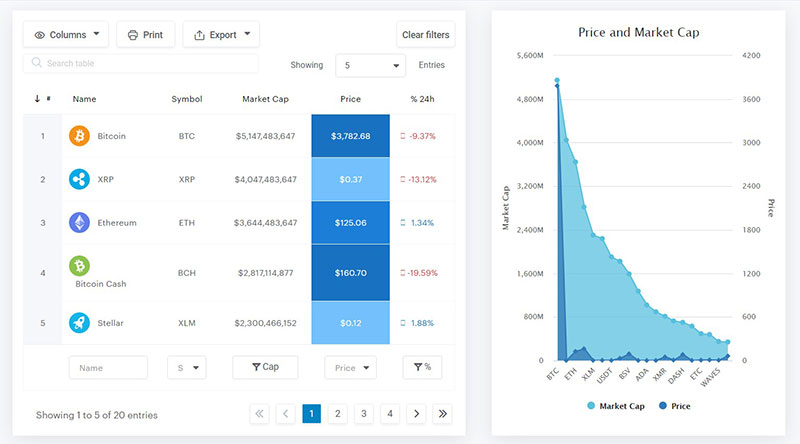
wpDataTables turns WordPress into an actual data platform rather than a page with a grid on it. Live database connections, chart engines, front-end editing, and server-side processing all sit inside one plugin.
The workflow itself stays simple. You provide the data, configure and customize the table, then publish it in a post or page. Everything else is optional depth you grow into.
It runs on roughly 70,000 active installs with a 4.6-star rating, and the vendor reports 66,000+ companies and individuals as customers. Worth noting that’s a tenth of TablePress’ install base, which reflects the different audience rather than a quality gap.
Data Source Connections in wpDataTables
Live sources supported:
- MySQL, MS SQL, and PostgreSQL databases with real-time sync
- Google Sheets through the secure Sheets API
- Excel, CSV, JSON, nested JSON, and XML inputs
Tables built from these read fresh data on load, so when the source changes, the table updates. TablePress can’t query a live database at all.
If you need to pull records straight from a database into a WordPress page, that alone is the reason to switch. You can go further with dynamic SQL queries using placeholders or pre-filter a table through the URL, so one table serves several pages.
Chart Generation From Table Data
wpDataTables ships with three chart engines: Google Charts, Highcharts, and Chart.js.
You build a chart from the same table rows through the Chart Creation Wizard, and it stays synced when filters change.
That covers the full visual range, from a clean bar chart to a pie chart to a scatter or gauge layout. TablePress offers none of it.
The Google Charts integration on its own replaces a second plugin most sites would otherwise install.
Front-End Editing and Conditional Formatting
Permitted users can edit table cells directly from the live page, inline or through a popover, without ever opening the WordPress admin.
Conditional formatting highlights cells, rows, and columns based on their values. Same idea as Excel’s rules.
Add formula columns and role-based access on cells, and the table starts behaving like a small app instead of a static grid. The spreadsheet-style extras stack up too: advanced filtering, sorting, row grouping, column totals, and export tools.
Presentation is covered as well. Tables are responsive by default, you can customize the styling, adjust layout and word wrap, or make a wide table scrollable. It drops into Gutenberg, Elementor, and Visual Composer without extra work. The full features page runs much longer than this.
Handling Large Datasets
Server-side processing keeps only the visible rows in the browser. The MySQL server handles the sorting and filtering.
The vendor’s own benchmark reports a 2,560,000-row table that would otherwise take 5 to 15 minutes to load running smoothly with server-side processing enabled (wpDataTables, 2024).
Treat that as a vendor figure, ours included. We didn’t reproduce a 2.5-million-row test. The underlying mechanism is the part that matters, though: pushing sorting and filtering down to the database instead of the browser is what makes tables that size workable at all.
Pricing Structure
A limited Lite version is free. Paid plans run as annual or lifetime licenses, with the single-site lifetime around $199 (wpDataTables, 2025). Confirm current pricing before you buy.
The Lite build covers basic tables, so the paid license is what unlocks live database connections, charts, and front-end editing. That’s the trade against a fully free core like TablePress or Ninja Tables.
What we found testing it: we connected a MySQL table and watched it update on page reload when the source changed, which is the single capability nothing else here offers. Building a chart from the same rows through the Chart Creation Wizard took a couple of minutes, and the chart stayed in sync when we applied a table filter. Front-end editing worked as described, with an editor role able to change cell values without touching wp-admin. Fair warning on scope: there’s more to configure than in TablePress, and the admin carries enough options that a first-time user spends a little time orienting before the payoff shows up.
What Makes Ninja Tables a Strong TablePress Alternative

Ninja Tables is the strongest free-first option here. Drag-and-drop building, responsive breakpoints, Google Sheets sync, and a free tier that isn’t a crippled demo.
It runs on 80,000+ active installs with a 4.6 rating from roughly 470 reviews (WordPress.org, 2026), making it the second-most installed table plugin in the category.
What stands out:
- Drag table cells to build layouts, no code
- Multiple table creation paths and a large style library
- Fluent Forms and WordPress post integration for pulling entries in
- Responsive breakpoints controlling which columns show per device
Charts, drag-and-drop building, front-end editing, and WooCommerce product tables sit behind the Pro license (verify current pricing on ninjatables.com).
What we found testing it: the table creation modal is the real differentiator. Instead of a single “add table” form, it asks how you want to build, manual entry, drag and drop, Fluent Forms connection, or an external source. The free build gave us responsive breakpoints that genuinely worked, hiding chosen columns per device without custom CSS, which TablePress gates behind its premium add-on. Drag-and-drop building and charts both prompted for Pro when we tried them. On our test dataset the free tier was the most capable of anything we didn’t pay for.
Where it falls short of wpDataTables is live SQL connections and raw dataset scale. Ninja Tables handles big tables fine for most blogs and affiliate sites. It just wasn’t built for enterprise MySQL queries.
How Does Data Tables Generator by Supsystic Compare
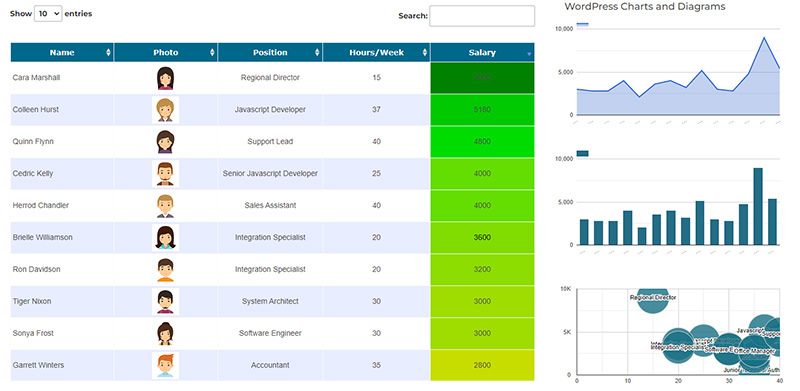
This one bundles tables, charts, and diagrams into a single plugin, with Google Sheets sync and PayPal-integrated tables in the paid tier. It fits small-to-mid datasets rather than enterprise-scale data.
What you get across the three sides of it:
- Tables: editable grid with sorting, filtering, and responsive output
- Charts: line, bar, pie, and more, built from the same table
- Commerce: PayPal buttons inside cells for pricing and product grids
What we found testing it: building a table and generating a chart from it worked, and getting both in one free-tier plugin is genuinely useful at this price point. The interface is the problem. Options are spread across tabs in a way that made simple tasks take longer than they should have, and we hit settings whose effect wasn’t obvious until we saved and previewed. Compared with Ninja Tables’ modal or TablePress’ spreadsheet grid, the orientation cost is noticeably higher for what the plugin actually delivers.
Good pick if you want charts and tables together on a budget. Weak pick if your data lives in a database or runs into six figures of rows.
Is League Table a Good TablePress Alternative

Only for one job: clean, heavily styled comparison tables. It’s a premium CodeCanyon plugin with strong visual controls out of the box, and no live data sources or charts whatsoever.
Think ranking tables, sports standings, top-10 lists. Static content that needs to look sharp.
What it does well:
- Deep styling controls without custom CSS
- Fixed and floating header rows for long tables
- Row highlighting to draw the eye to a top entry
What we found testing it: this was the fastest route to a table that looked designed rather than defaulted. Styling controls that would mean writing CSS elsewhere are exposed as settings, and the floating header held position correctly on a long scroll. Then we went looking for a data source beyond manual entry and there isn’t one. No Sheets, no SQL, no chart engine. What you type is what stays, permanently.
Pricing is a one-time CodeCanyon purchase with no annual renewal, which is the appeal for anyone allergic to subscriptions.
Next to wpDataTables it’s a narrow tool. Beautiful for the one thing it does, useless for dynamic data.
When Should You Choose Posts Table Pro

Choose it when the table should build itself from content you already have. It queries posts, pages, products, and custom post types automatically, so the table updates as your content changes.
That’s the key difference from every other plugin here. You’re not typing rows. You’re pointing the plugin at existing content.
| Pulls From | Common Use |
|---|---|
| Posts and pages | Searchable blog archives |
| Custom post types | Directories, libraries |
| WooCommerce products | Product lists, order forms |
| ACF fields, taxonomies | Filtered content grids |
It reads Advanced Custom Fields and ACF Pro data, plus custom taxonomies, and stays responsive across devices.
What we found testing it: we pointed it at a set of existing posts and had a sortable, searchable table without entering a single row, which is a genuinely different workflow from everything else here. Publishing a new post added it to the table automatically. This is the one job wpDataTables doesn’t do natively, so for a content-driven site it’s the better tool regardless of our ranking. The limitation is the flip side of the same design: it queries WordPress content, so there’s no path to a table from a CSV or a database that isn’t already in WordPress.
One documented use is a choir website listing sheet music and audio files with working sort, filter, and search. That’s the sweet spot: a document library built from media you’ve already uploaded.
Pricing starts around $89/year for a single site, rising to an agency license. Check barn2.com for current tiers.
Skip it if you need tables from raw data or a database query. It queries WordPress content, not spreadsheets.
Does Visualizer Work as a Free TablePress Alternative

It works if charts are your priority and tables are the afterthought. Visualizer is chart-first, table-second, running on 40,000+ active installs (WordPress.org, 2026).
It essentially flips the TablePress model. TablePress does tables and no charts. Visualizer does charts, with a table as a side feature.
| Tier | What You Get |
|---|---|
| Free | Core chart types (line, bar, pie, table) on Google Charts and Chart.js |
| Pro | Around 11 more types (area, geo, bubble, scatter, candlestick, gauge, others), roughly 15 total, plus CSV, Sheets, and chart imports |
The free version is oriented around manual data entry. Live database queries and front-end editing sit in Pro, and pricing there changes with promotions, so confirm on the ThemeIsle site.
What we found testing it: the free build produced a clean, embeddable chart faster than any other plugin here, which is exactly what it’s for. Entering data manually is the default path, and importing anything beyond that prompted for Pro. The table output is functional but plain, closer to a chart’s data view than a real table tool, so treating this as a TablePress replacement only works if the chart is the point and the table is incidental.
Fair pick for a blogger who wants an interactive chart embedded in a post without paying. Weak pick as a pure table tool, since the table side is thin next to wpDataTables or Ninja Tables.
wpDataTables vs TablePress Feature Comparison
wpDataTables wins on data connections, dataset scale, and charts. TablePress wins on free-tier simplicity, and on being the lightest plugin in the category. Which matters more depends on whether you run a content site or a data-driven one.
| Feature | wpDataTables | TablePress |
|---|---|---|
| Live data sources | MySQL, MS SQL, PostgreSQL, Sheets | No direct SQL; file/URL import only |
| Max rows | Very large (server-side) | Slows past ~10,000 |
| Charts | 3 engines built in | None |
| Front-end editing | Yes | No |
| Free version | Limited Lite | Full free core |
| Page weight | Heavier, more assets | Lightest in the category |
What we found comparing them directly: on a small table, TablePress was faster to set up and lighter on the page, and we’d pick it over wpDataTables for a simple blog table without hesitating. The gap only opens as the dataset grows or the requirements change. TablePress’ full free core is also a real advantage that no amount of feature depth cancels out for someone with no budget.
The pattern is clear enough. TablePress is the better free starting point for a simple table on a blog.
wpDataTables is the better platform once your data lives in a database, runs into serious row counts, or needs charts from the same numbers.
One practical note on switching: TablePress exports to CSV and Excel, and wpDataTables imports both directly, so migration doesn’t mean rebuilding from scratch.
Migrating Tables From TablePress to wpDataTables
- Export the TablePress table as CSV or Excel from its edit screen
- In wpDataTables, create a table from that file with the Table Creation Wizard
- Rebuild sorting, filters, and styling in the new editor
We ran this migration on our test table and the data moved cleanly on the first attempt. Formatting and shortcodes don’t carry over, so budget time to reapply table styling and layout and swap the old shortcodes on your pages.
How to Choose the Right TablePress Alternative for Your Site
The ranking table above gives the order. This section covers how to work the decision, since the right answer depends on your data source and dataset size far more than on any overall ranking.
Work the questions in this order:
- Data source first. If it’s a database or a live Google Sheet, wpDataTables is the only pick that handles it well. If it’s WordPress content you’ve already published, Posts Table Pro is the better tool
- Size second. Past a few thousand rows you need server-side processing, which rules out most of the field, including TablePress
- Charts third. Need graphs from the same data? wpDataTables for tables-plus-charts, Visualizer if the chart is the whole point
- Budget last. Tight budget and simple needs point straight back to Ninja Tables or TablePress itself, and there’s no shame in that being the right answer
WordPress runs more than four in ten websites, so “the best plugin” always depends on the site rather than a universal ranking.
For data-driven sites, wpDataTables is the answer. It closes every gap TablePress leaves open, and it’s the one tool here built to handle and visualize large data sets without dragging your site down. For a blog with a pricing table on one page, it’s more plugin than the job needs.
Common Questions About TablePress Alternatives
What is the best TablePress alternative?
wpDataTables is the best alternative for data-driven sites. It connects to MySQL, PostgreSQL, and Google Sheets, handles very large datasets through server-side processing, and builds charts from the same table data. TablePress does none of these natively. For a simple static table, TablePress remains the lighter, cheaper choice.
Is wpDataTables better than TablePress?
For dynamic data, yes. wpDataTables wins on live database connections, dataset scale, charts, and front-end editing. TablePress wins on free-tier simplicity and page weight. Choose TablePress for static manual tables, wpDataTables for large or database-driven data.
Is there a free TablePress alternative?
Yes. Ninja Tables offers a genuinely usable free tier with responsive breakpoints and multiple table types. Visualizer is free for chart-first work. wpDataTables has a limited Lite version, though its strongest features sit behind a paid license.
Why do people switch away from TablePress?
It won’t connect to a live database, generate charts, or allow front-end editing. Large datasets past roughly 10,000 rows slow down because tables load fully into the DOM. Those gaps push data-heavy sites elsewhere. Sites that don’t hit those gaps generally stay.
Can wpDataTables handle large datasets?
Yes. Server-side processing keeps only visible rows in the browser while MySQL handles sorting and filtering. The vendor benchmarks a 2,560,000-row table loading smoothly with this enabled, against 5 to 15 minutes without it (wpDataTables, 2024). That’s our own figure, so weigh it accordingly.
Which TablePress alternative works best with WooCommerce?
Posts Table Pro pulls WooCommerce products, prices, stock levels, and Add to Cart buttons into tables automatically. Ninja Tables Pro also builds product tables. Both suit stores better than TablePress, which has no native WooCommerce integration.
Does wpDataTables create charts?
Yes. It ships with 3 chart engines: Google Charts, Highcharts, and Chart.js. You build charts from the same table rows through the Chart Creation Wizard, and they stay synced when table filters change. TablePress offers zero charting.
How much does wpDataTables cost?
A limited Lite version is free. Paid plans run as annual or lifetime licenses, with single-site lifetime access around $199 (wpDataTables, 2025). No full free core, which is the trade-off against Ninja Tables and TablePress.
Can I migrate my tables from TablePress?
Yes. Export your TablePress table as CSV or Excel, then import it into wpDataTables with the Table Creation Wizard. Data transfers cleanly. Styling and shortcodes don’t carry over, so budget time to reapply formatting.
Which alternative is best for displaying existing WordPress content?
Posts Table Pro is built for this. It queries posts, pages, custom post types, and ACF fields automatically, so tables update as content changes. You point it at content you already have instead of entering rows manually. wpDataTables doesn’t cover this use case natively.
Conclusion
Picking between TablePress alternatives comes down to what your data actually needs to do.
For static tables on a blog, TablePress or Ninja Tables gets the job done for free.
But the moment you need live MySQL connections, server-side processing, or interactive charts from the same rows, wpDataTables pulls ahead of everything else here.
Posts Table Pro suits sites showing existing WordPress content. Visualizer fits chart-first budgets. League Table handles styled comparison tables.
Each plugin solves a specific problem, so match the tool to your site type, dataset size, and budget.
Run through those factors honestly, and the right WordPress table plugin becomes obvious.
For most data-driven projects, that answer is wpDataTables.